
Western Harbour Tunnel Stage 2
Project Overview
 Western Harbour Tunnel is delivering enduring quadruple-bottom-line benefits, setting a benchmark within transport infrastructure. The project’s environmental footprint was reduced significantly - with a 35% reduction in lifecycle material impacts and eliminating 900,000 m³ of dredging in Sydney Harbour - while strengthening community outcomes through the early revitalisation of 1.9 hectares of public space at Berrys Bay.
The project also drove economic value, awarding over $87 million in contracts to Aboriginal businesses and expanding pathways for underrepresented groups. These outcomes are driven by aligned leadership and a regenerative-by-design mindset. From the outset, the ACCIONA and Transport for NSW (TfNSW) Project Directors fostered a One Team culture, empowering every discipline to challenge business-as-usual and take shared responsibility for sustainability.
A collaborative contract with TfNSW also supported open dialogue and integrated problem-solving. Early resource modelling shaped decisions, with sustainability practitioners training design teams in tools to enable iterative optimisation and data‑driven choices. Intentional engagement with Aboriginal Knowledge Holders and local communities ensured cultural narratives and community values were embedded in permanent works. The shift from an immersed tube tunnel to a tunnel boring machine methodology served as a catalyst for this ethos- but shared ownership across teams ultimately delivered these outcomes.
Outcomes
Western Harbour Tunnel has delivered significant environmental, social, cultural and economic outcomes, reflecting the team’s alignment around regenerative design.
Environmental Outcomes - Decarbonisation & Circularity
- 35% reduction in lifecycle material impacts from original reference designs, driven by design optimisations including: - Removal of a floor in the Cammeray Ventilation Building (11% reduction).
- Optimised tunnel panel design (6% reduction).
- High‑SCM concrete mixes (6% reduction).
- 39% average SCM concrete content, replacing 30,763t of cement with lower‑carbon alternatives.
- Fibre‑reinforced shotcrete reduced material use by ~15%, avoiding 4,462t of shotcrete and ~1100 tCO₂e.
- 100% renewable electricity for construction, avoiding over 34,000 tCO₂e.- 3,024,431 m³ of clean spoil beneficially reused.
- 900,000 m³ of dredging eliminated, preventing disturbance and partial offshore disposal.
- Significant non‑potable water reuse:
- 310,748 kL reused during construction (124 Olympic pools), enabled through early collaboration on temporary site designs.
- 42% reduction in potable water use across design life (2,560 ML saved), driven by fire suppression system optimisation and prioritising reuse in water treatment.
- Trials of several innovative technologies, including a digital design model with embedded life cycle material impact footprints, 3D‑printed concrete and recycled‑plastic TBM spacers.
Social Outcomes – Supporting Communities & Environments-
 Tens of thousands of heavy vehicle movements avoided in Rozelle through spoil haulage diversion via WestConnex.- An underground slurry treatment plant removed intrusive surface‑level infrastructure, preventing significant visual amenity and community impacts.
- Eliminating tunnelling support sites enabled the fast-tracked delivery of the Berrys Bay Masterplan, revitalising the 1.9ha site into public open space years earlier than planned - delivering on the TfNSW Sustainability Plan and ACCIONA business as unusual principles.
- Co-design workshops with local schoolchildren and Aboriginal Knowledge Holders embedded community values and narratives into designs.- Transparent engagement drove strong participation in the public exhibition of the Place, Design, and Landscape Plans:
- Tunnel infrastructure design: 260+ responses
- Berrys Bay Design: 100+ responses Cultural Outcomes
- Honouring Country- The Passing Knowledge design narrative, created with local artist Dennis Golding, embeds Aboriginal storytelling and cultural motifs throughout the tunnel interior.
- TBMs Barangaroo and Patyegarang honour two influential Aboriginal women through naming and bespoke artworks by local artist Taleena Simon, strengthening cultural representation.
- An oral history program is preserving Berrys Bay cultural narratives at the NSW State Library.- An on‑Country retreat with Aboriginal Knowledge Holders led to the creation of a traditional nawi for inclusion in permanent works.
Economic & Workforce Outcomes
– Inclusion & Uplift- Over $87 million in contracts awarded to Aboriginal businesses.
- Ongoing Aboriginal Subcontractor Forums and a five‑year partnership with ARA Indigenous Services driving industry capability
- Two Pre‑Employment Programs created upskilling and employment pathways for 19 women, including six women transitioning out of corrections.
- The Building Futures initiative and TfNSW STEM programme engaged 60 Year 10 students, providing insights on construction careers, with two students later joining the Project for traineeships.
- Women represent 50% of the workforce at the Emu Plains precast facility.
Impact
The benefits of Western Harbour Tunnel’s approach extend across communities, cultures, industries and ecosystems.
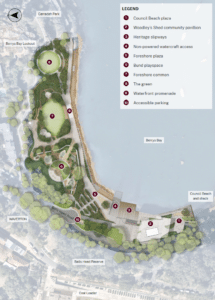 Local communities have experienced significantly reduced construction impacts. Diverting spoil haulage via the WestConnex network has kept heavy vehicles off residential streets, while placing the slurry treatment plant underground removed a major source of visual, noise and traffic disruption at the Glebe Island site. The accelerated delivery of Berrys Bay provides 1.9 hectares of inclusive, high‑quality public open space, strengthening community wellbeing and connections to the foreshore years ahead of schedule.
Aboriginal communities and Knowledge Holders have shaped outcomes that honour the cultural and historical significance of Cammeraygal and Wangal Country. Codesign of artwork, cultural protocols and placemaking ensures their knowledge is embedded within the project experience. Economic benefits are also substantial, with more than $87 million in contracts awarded to Aboriginal businesses and continued support through capability-building partnerships and forums.
Women and under‑represented jobseekers benefit from targeted construction employment pathways that provide skills, qualifications and long‑term opportunities - from school‑based traineeships to pre‑employment programs, even extending standard practices to include and engage women transitioning back into the community after incarceration.
Industry and government gain industry insights from scalable decarbonisation methods, circular material practices, and a replicable governance structure where sustainability is owned across all disciplines. These outcomes contribute to broader capability uplift across the NSW infrastructure sector.
Finally, the environment and Country benefit through reduced resource consumption, lower emissions, protected waterways and regenerative public spaces that support biodiversity and cultural connection well into the future.
Legacy and UN SDG Contributions
What LEGACY and UN SDG CONTRIBUTION was achieved? The legacy of Western Harbour Tunnel is defined by its commitment to regeneration - restoring natural systems, celebrating cultural identity, uplifting communities and reshaping how major infrastructure is delivered in NSW.
Environmental legacy (SDGs 6, 12, 13, 14, 15)
WHT demonstrates a shift from reducing impact to creating positive environmental value. A 35% reduction in material life‑cycle impacts, 100% renewable electricity for construction and full beneficial reuse of over 3 million m³ of spoil to date reflect a systemic commitment to responsible resource use (SDG 12.5). The reuse of 310,748 kL of potable water during the construction phase and 2,560ML projected over the tunnel design life supports long‑term water resilience (SDG 6.4). Protecting marine and intertidal environments contributes to healthier coastal ecosystems (SDGs 14.1, 14.2). At Berrys Bay, regenerative design enhances green corridors, increases native habitat and strengthens local biodiversity (SDGs 14.5, 15.1).
Cultural and community legacy (SDGs 3, 10, 11)
The Passing Knowledge narrative creates a unique cultural journey through the tunnel, ensuring Country remains visible and celebrated. Knowledge Holder collaboration at Berrys Bay and throughout the design process strengthens cultural expression and embeds community identity into the project. The fast-tracked delivery of Berrys Bay provides safe, inclusive public open space (SDG 11.7), while reduced community construction impacts support healthier urban environments (SDG 11.6). Finally, employment and procurement pathways uplift women and Aboriginal businesses, contributing to reduced inequalities and improved social and economic participation (SDGs 3.4, 10.2).
Industry transformation and governance legacy (SDGs 9, 12, 17)
WHT demonstrates how strong leadership, transparent collaboration with TfNSW, and integrated governance can embed sustainability across all disciplines. The project has advanced low‑carbon design practices, circular material approaches and supplier innovation trials (SDGs 9.4, 12.2). Through open reporting, industry forums and co‑design processes, WHT contributes to collective learning and strengthens long‑term partnerships across industry, community and government (SDG 17.16). Together, these contributions form a legacy that extends beyond the project footprint: a regenerative approach to infrastructure that honours Country, uplifts communities, restores nature and shapes the future direction of sustainable delivery in NSW.