Description
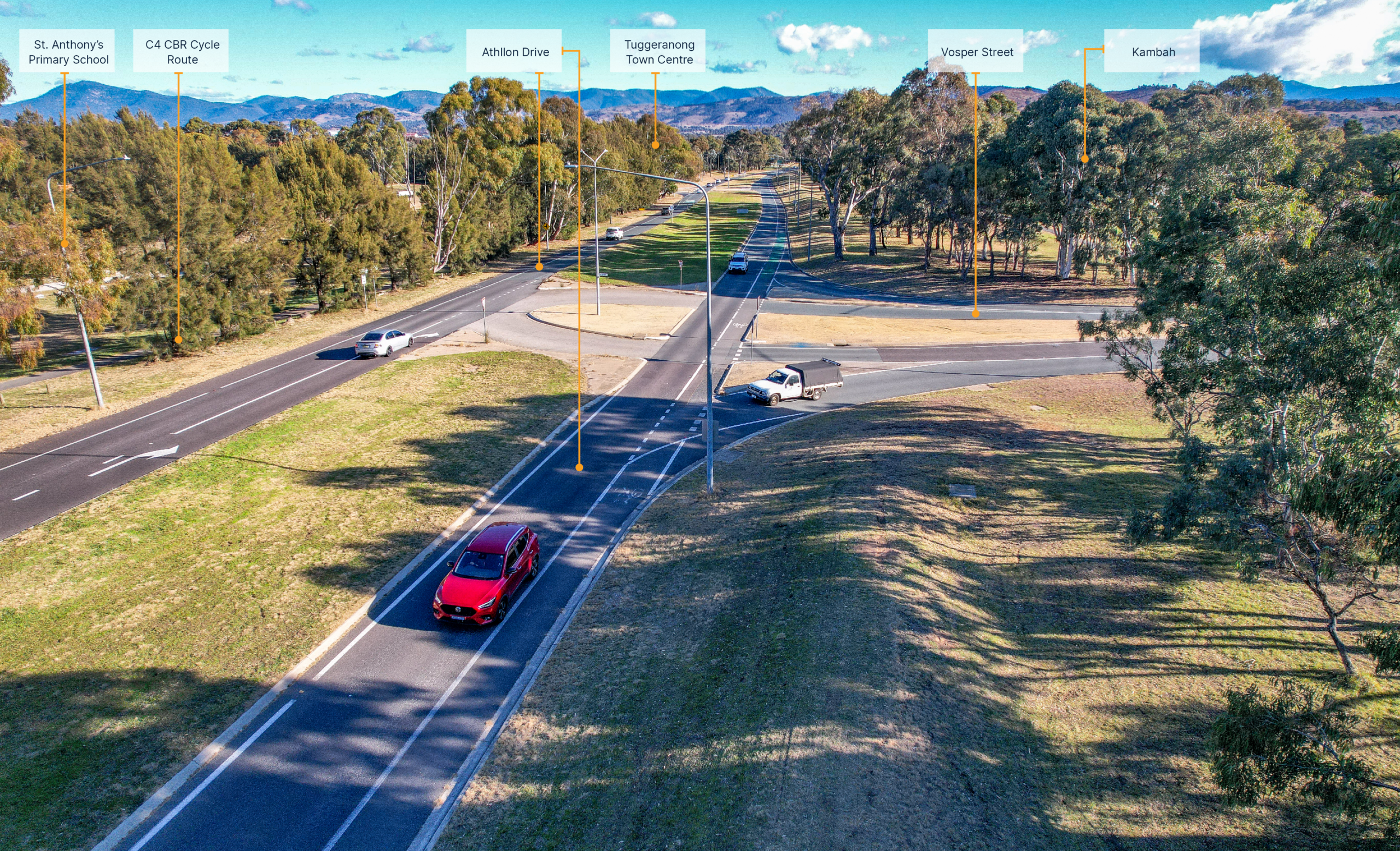
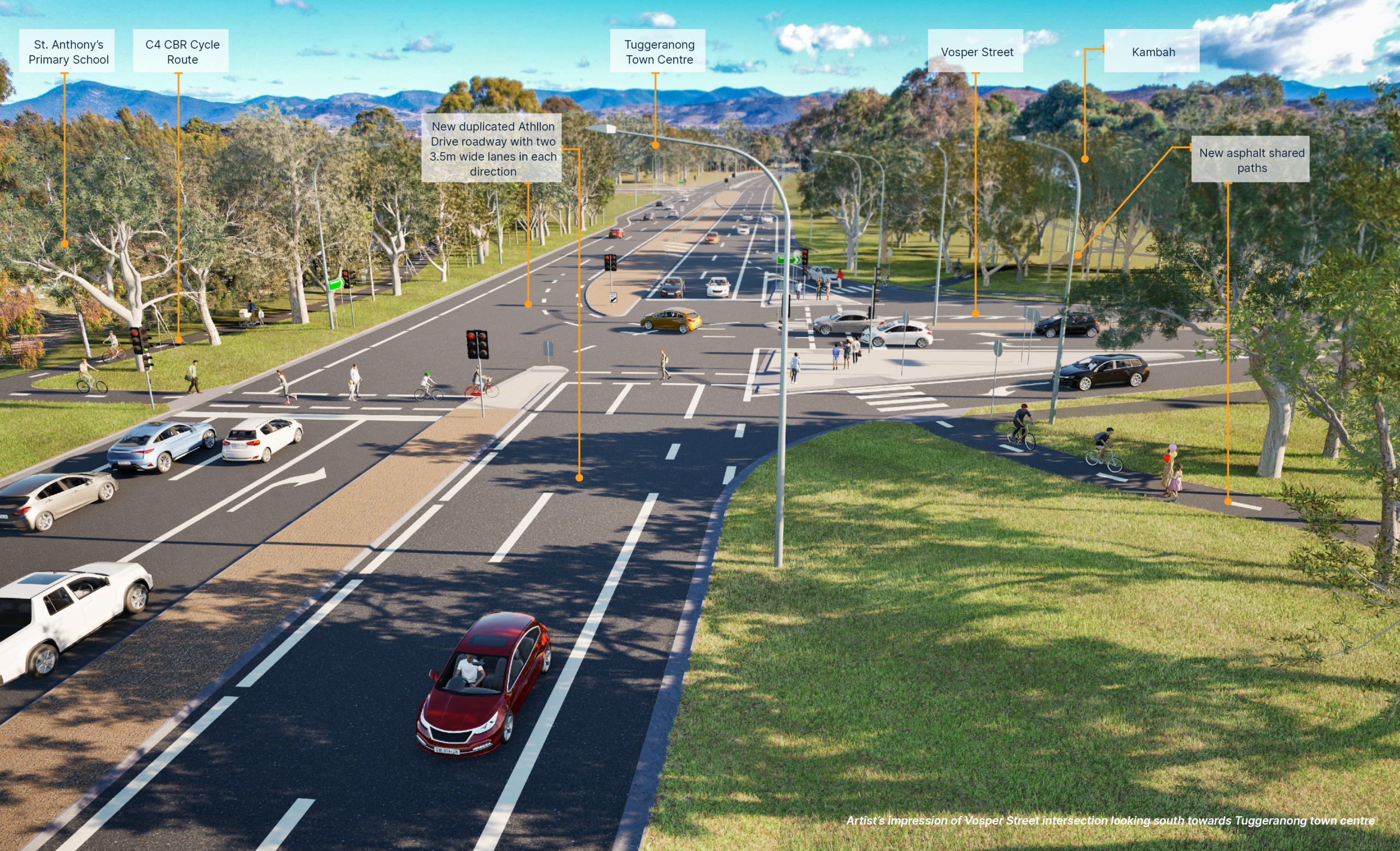
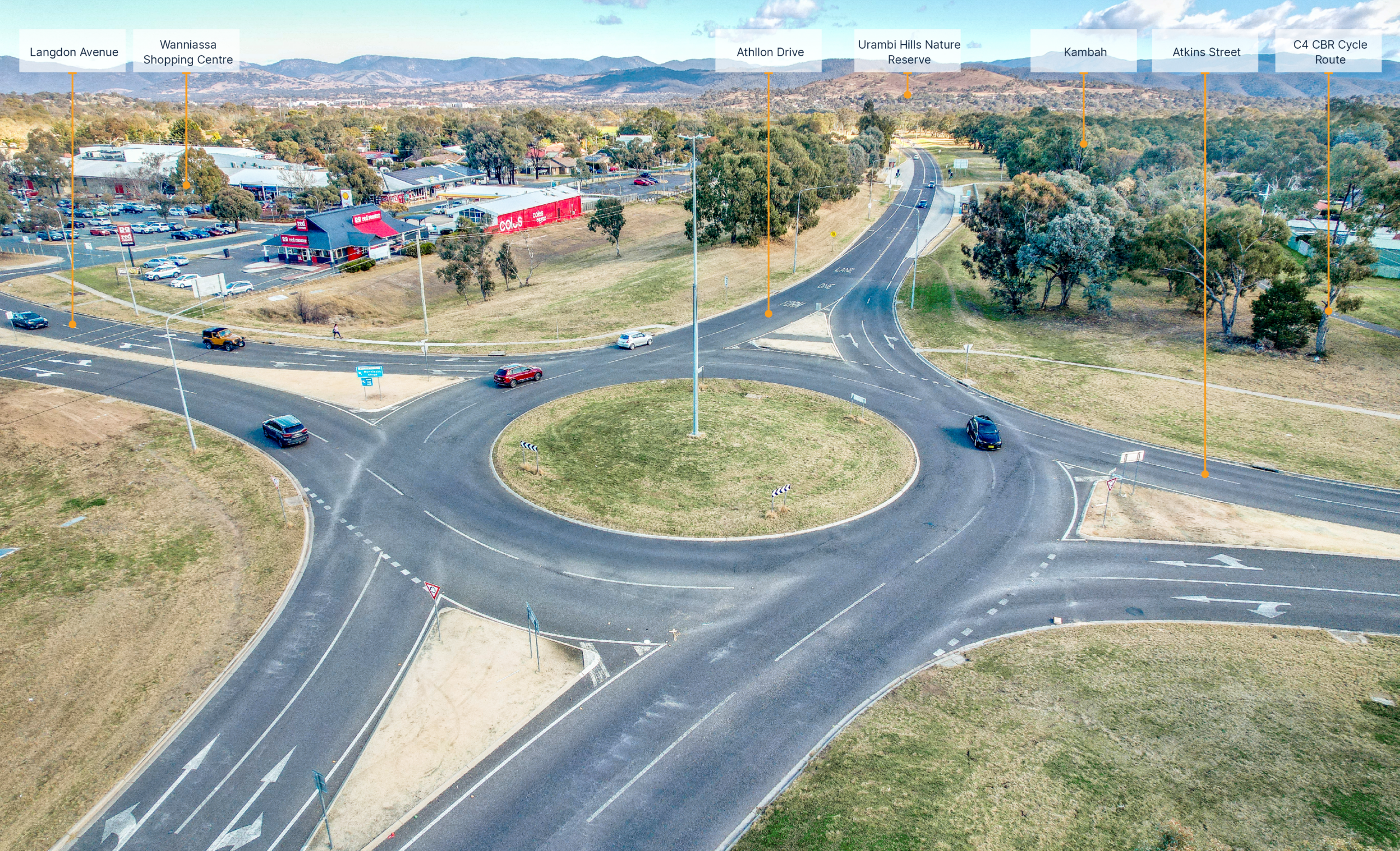
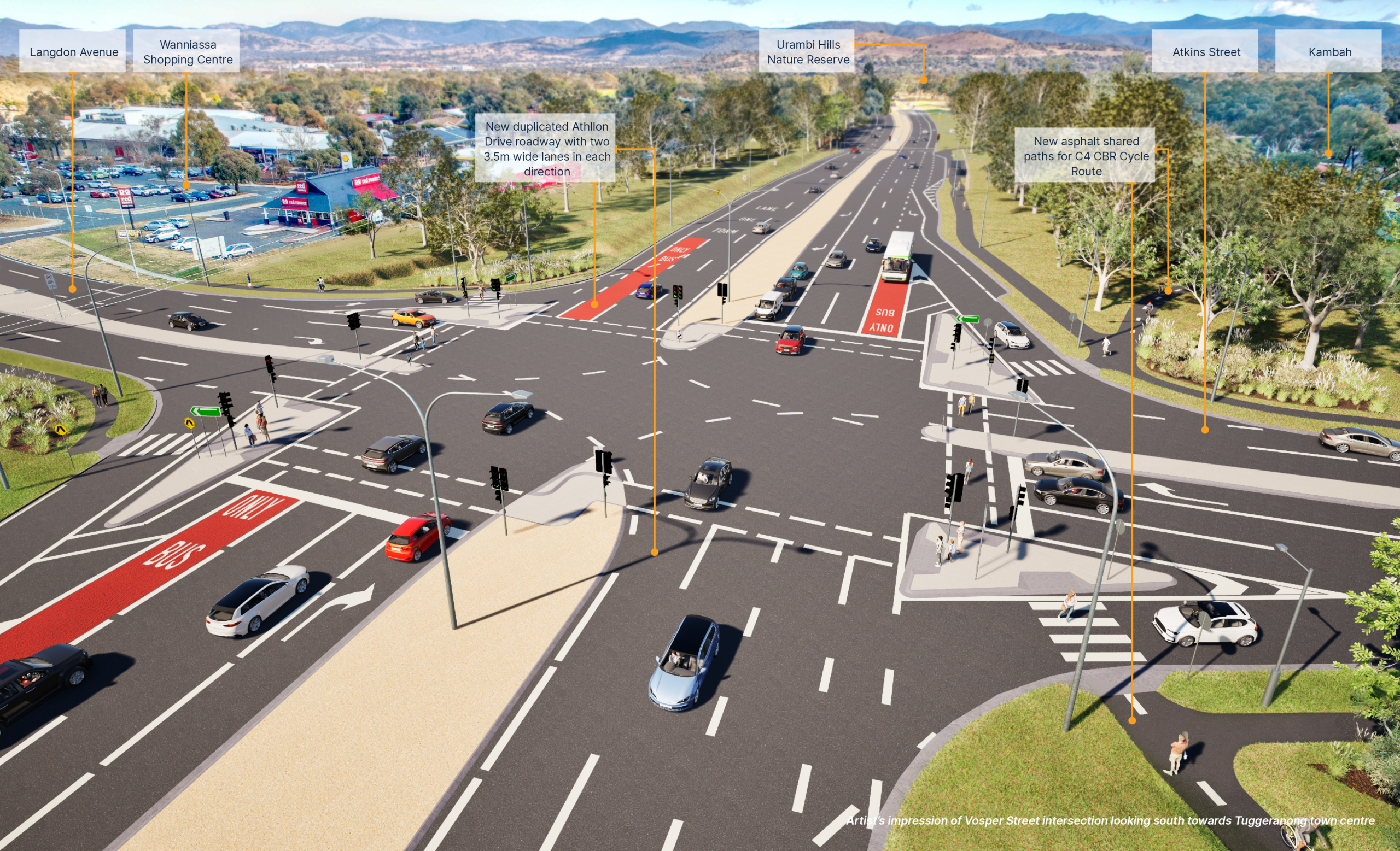
The Athllon Drive Duplication (Southern Package) Detailed Design project involved the upgrade and duplication of a 2.4 km section of Athllon Drive between Sulwood Drive and Drakeford Drive in Canberra. Delivered for Infrastructure Canberra, the project aimed to improve network capacity, road safety, public transport accessibility, and active travel connectivity while supporting future growth in the Woden and Tuggeranong regions through a modern, multimodal transport corridor.
Acknowledgements
People:
ICBR:
- Edward Owens
- Darren Smith
- Shane Randall
- Amrit Adhikari
SMEC:
- Sophie Quinn
- Hugh Selby
- Samantha Naidoo
- Thomas Meadows
- Kimberley Decanha
- Jaun Meyer
- Maria Austria
- Lachlan Beckworth
- Dan Paje
Suppliers:
Bagariin Consulting (First Nations and Indigenous engagement)
Renzo Tonin & Associates (Noise and Vibration Specialist)
MADE LA (Urban and Landscape)
Atlan Stormwater (Product innovation)
Zephyr Environmental (Air Quality Specialist)
Umwelt Consulting (Environmental Specialist)
Past Traces (Heritage Specialist)
Rating Highlights
| Category | Credits | Achievements |
| Environment | Eco-1 | Level 3
The project achieved a quantifiable net ecological gain through an integrated avoid, minimise and restore approach. Strategic alignment and tree-protection measures reduced impacts to existing ecological values, while 638 trees were incorporated into the landscape design to address the removal of 315 trees, increasing the total live-tree population from 3,505 to 3,828, a net gain of 323 trees or approximately 9%. The design also provides 0.41 ha of native groundcovers, grasses and shrubs, compared with 0.01 ha of native pasture removed, targets 30% canopy cover, and improves habitat connectivity between Lake Tuggeranong, Farrer Ridge Nature Reserve and Mount Taylor Special Purpose Reserve. All ecological improvement measures comprise 100% project-led, on-site restoration, with no external biodiversity offsets required. |
| Governance | Res-1 | Level 3
The project adopted a comprehensive and collaborative approach to climate and natural hazard risk management, integrating climate resilience considerations into project planning and design. Risk identification, assessment and treatment were informed not only by the multidisciplinary design team, but also by a broad range of government stakeholders and technical specialists, including flooding and hydrology, urban planning, active transport and asset management representatives. This cross-disciplinary engagement strengthened the assessment of direct and indirect risks and informed resilient design outcomes. While only targeting Level 2, the project was ultimately awarded Level 3, recognising the maturity and breadth of its stakeholder-led climate resilience approach. |
| Governance | Pla-2 | Level 2
A comprehensive Urban and Landscape Design Plan was developed and independently reviewed, with design outcomes informed by site analysis, heritage and environmental assessments, and stakeholder engagement. The project retained and protected significant heritage and high-value trees, incorporated WSUD elements, and committed to planting 642 native trees to achieve a 2:1 replacement ratio for vegetation removal. The design supports ACT Government canopy cover objectives, biodiversity connectivity, active transport accessibility, and long-term landscape resilience, while maintenance arrangements were established and independently reviewed to ensure ongoing performance of landscape assets. |
| Social | Sta-2 | Level 2
The project implemented a structured stakeholder engagement process that enabled key stakeholder and community input to directly influence project outcomes. High-priority issues relating to active travel safety, cultural heritage protection, and public transport access were identified through engagement activities and incorporated into the design. Stakeholder feedback contributed to the inclusion of a grade-separated active travel underpass, design refinements to avoid heritage values and protect culturally significant trees, and improvements to public transport facilities. Project responses were communicated back to stakeholders, with evidence demonstrating stakeholder acknowledgement that concerns had been addressed. |
| Environment | Rso-6 | Level 2.73
Through targeted design optimisation and material efficiency measures, the project achieved a 41.01% reduction in material life cycle impacts relative to the verified Base Case. Key initiative included reducing pavement thickness from 840 mm to 560 mm, optimising asphalt quantities which helped deliver substantial reductions in embodied environmental impacts while maintaining required engineering outcomes. |
| Governance | Lea-1 | Level 2
Sustainability was embedded into project governance through a materiality-driven ISMP that established SMART targets, clear accountabilities, quarterly performance reporting, stakeholder-reviewed sustainability commitments, and publicly disclosed project targets. This ensured sustainability considerations were integrated into decision-making, continuous improvement, and project delivery processes. |
| Environment | Ene-1 | Level 2.02
Achieved an estimated 14% reduction in whole-of-life energy demand, through a combination of design optimisation measures and low-carbon construction initiatives. Key contributors included pavement thickness optimisation, reduced earthworks associated with noise mound redesign, hybrid generators, solar-powered lighting towers, grid-connected site offices, and the assessment of electric and hybrid construction plant and vehicles. Achieved an estimated 14% reduction in whole-of-life carbon emissions, compared to the verified Base Case. The reduction was driven by design efficiencies that reduced material and fuel requirements, alongside opportunities to transition construction activities to lower-carbon technologies. The project further leveraged the ACT's 100% renewable electricity supply, enabling additional emissions reductions through the use of grid-connected site facilities and electrification opportunities. |
| Environment | Env-2 | Level 2
A project-specific noise management framework, including baseline assessments, construction and operational noise modelling, SMART noise goals, and targeted monitoring requirements was established. In the ACT context, the project proactively developed clear and measurable noise performance objectives to guide design and construction decision-making and provide a robust basis for monitoring and compliance. Modelling demonstrated compliance with these goals through the incorporation of mitigation measures, including operational noise mounds, with no recurring or major exceedances predicted. |
| Environment | Env-4 | Level 2
Comprehensive air quality assessments identified sensitive receptors, established project-specific SMART targets, and modelled construction and operational impacts against NEPM criteria. Results demonstrated no recurring or major exceedances, while a suite of proactive mitigation measures, including real-time dust monitoring and TARP-based response actions, were embedded into project delivery to protect community health and amenity. |
| Social | Sta-1 | Level 1
A project-specific Stakeholder Engagement Strategy was developed, approved by a suitably qualified professional and embedded into project governance. The strategy established clear engagement objectives, stakeholder management processes, complaints handling and performance monitoring, with implementation demonstrated through extensive community engagement activities, consultation records, reporting frameworks and integration into project risk and delivery processes. |
| Governance | Lea-3 | Level 2
The project delivery included facilitating extensive sustainability knowledge sharing across multiple departments within Infrastructure Canberra, embedding lessons learned from IS Essentials implementation into broader organisational practice. Knowledge-sharing sessions, business planning presentations, lessons-learned workshops and cross-project exchanges with Canberra Light Rail and Queensland Transport and Main Roads enabled project teams, asset owners, delivery teams and contract managers to build capability in sustainability ratings and sustainable infrastructure delivery. These initiatives strengthened interdepartmental collaboration, improved organisational competency, and supported the transfer of sustainability knowledge across projects and government agencies. |
Verified Innovations
| Name | Innovation Type | Description |
| Bioretention System on Major Road Infrastructure
|
Innovation claim: First’ innovative technology, process or method
|
The project incorporates a bioretention system as a Territory-first application on a major ACT road project. The innovation overcomes the space constraints typically associated with major road corridors by enabling water quality treatment infrastructure to be installed close to the roadway. The system treats stormwater runoff by removing sediments, hydrocarbons, heavy metals and nutrients prior to discharge, while also providing detention capacity, enhancing flood resilience and contributing to urban heat mitigation through integrated vegetation. This demonstrates a practical, scalable and replicable nature-based solution for delivering improved environmental outcomes on transport infrastructure projects. |