
The Towradgi Station Upgrade Project was part of the third tranche of Transport for NSW’s Transport Access Program, known as TAP 3, which seeks to improve access to public transport for people with disability or limited mobility, parents and careers with prams, and customers with luggage. Providing accessible transport services for everyone in the community is one of the six priorities for Transport for NSW’s Future Transport Strategy. Upgrading train stations provides fair and equitable access for all customers, as well as improving connections between the station and key destinations in the area.
Works at Towradgi Station included:
- A new footbridge over the rail corridor connecting the two platforms of Towradgi Station.
- Two new lifts which have three stops including platform level, road/pedestrian level and footbridge level. Lift landings also have weather protection canopies at the waiting areas.
- New footpaths that connect Towradgi Road and Weber Crescent to the station and the new footbridge, as well as footpaths to the new accessible car spaces and kiss and ride area.
- Two accessible car parking spaces and a kiss and ride zone on Weber Crescent.
- New stairs on either side of the footbridge.
- Construction of a new station services equipment room (SSER) next to Weber Crescent.
As Built Rating Highlights
Climate Change and GHG emissions - Cli-1 and 2, Ene-1 and 2
- Respond to climate change: A comprehensive Climate Change Risk Assessment (CCRA) was undertaken with relevant stakeholders (inc. TfNSW, Degnan, SMEC, etc). Using TfNSW’s climate risk assessment tools that eliminated all Extreme and High risks for a residual 91% of risks as Low for the Project.
- Energy/GHG Reductions: The Project has achieved an 39% reduction in energy consumption over the Project life-cycle of 50 years and an 81.4% lifecycle greenhouse gas emissions reduction (as compared to the Base Case scenario). These significant achievements were made possible through maximising the efficiency of the design of the lift shaft ventilation system, the inclusion of passive ventilation louvres, the use of solar-powered street lighting poles, the installation of low-power LED lighting built in to handrails and a Sydney Trains purchasing agreement for operation electricity to be carbon offset.
Renewable Energy
- The Project installed solar-powered streetlights which have no reliance or draw on the municipal grid. These were used on Council land in the land-scaped entry walkways. Figure 1 shows the pathway utilising the lights.
- The Project utilised Lumorail in the handrail design, a product that houses LED-strip lighting on the bottom of the rail. This not only enhances the aesthetics of the station but provides a lower-power lighting option as the light intensity needed to create the same luminance is reduced.
Improved environmental outcomes Wat-1, Mat-1, Dis-1 to 5
- Improve environmental outcomes – Water saving The Project has achieved a 17.8% water use reduction during the life-cycle of 50 years, supporting the NSW Government’s commitment to resource efficiency. During construction, 44% of construction water used was non-potable, locally-captured, rainwater
- Materials Impact Reduction The Project has achieved a 12% reduction of materials environmental impact (i.e. IS EnviroPoints) as compared to the Base Case scenario. This achievement equates to a saving of 140 t CO2e.
Connecting with communities / Respect culture and heritage Hea-1 / Her-1
The project has undertaken several community-based initiatives:
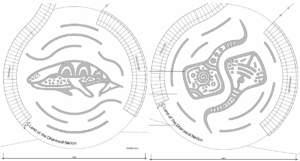
- Aboriginal Involvement in Design: The Project has put considerable effort into Aboriginal involvement through Project from the very beginning. Even through COVID restrictions, the Project was determined to engage with local Aboriginal Elders and Knowledge Holders of the Wodi Wodi – Saltwater People of the Dharawal Nation. The Aboriginal stakeholders generously shared their stories and their vision of the station upgrade which formed the basis of many of the Project’s key elements. For example, the main entry walkway for the station was envisioned by the Aboriginal Elders to represent theocean, and in particular the Sperm Whale, the totem animal of the Wodi Wodi People. The designs in Figure 3 display the intent of the seating area and the symbolism of the ocean life.
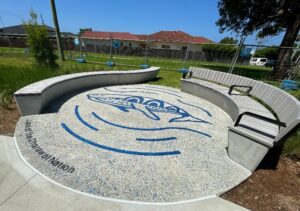

- These design inputs were facilitated by the involvement of Aboriginal architects, Ngulaway Design Inc., TfNSW’s Aboriginal Engagement Team, and Coomaditchie, a local Aboriginal Corporation ‘dedicated to raising the esteem, pride and dignity of young Aboriginal people in their Aboriginal culture and heritage’.
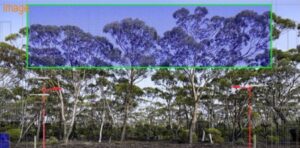
- The station incorporated a CNC cut aluminium screen that follows the shape of native tree tops outline and provides an architectural focus element that is accented at night with the backlighting provided by the pathway lights. This design element provides the required security screening while improving the appeal of the station for local residents.


- Inclusion of an Adult Change Table In line with the TAP3 program’s intent of making transport accessible to a wider range of abilities, Wollongong City Council requested that the station’s toilet facilities be augmented with an adult change table for use by relevant members of the disabled community. This is the first Adult Change Table for the South Coast Railway line, highlighting the importance of communicating with external stakeholders.
- Primary School Competition for Mural The Project ran an art competition with the local Towradgi Primary School to come up with a design for a mural to be painted on the amenities building at the station. The competition was a huge success, with many entries from the children. A local artist was then commissioned to create an building-covering artwork that reflected the coastal area based on the winning students drawing. Ultimately, this provides personality to the structure, improved the character of the station, and instilled a sense of pride and identity for the school children with their local station.


Verified Innovations
Use of novel Air-entrained Concrete

 Degnan partnered with the University of Wollongong (UOW) to trial an innovative new building material. The product Air-Entrained (Foamed) concrete, was developed by UOW’s Sustainable Building Research Centre. The Foamed Concrete material had not been used previously in Australia. The Foamed Concrete panels were used as cladding for the station services equipment room (SSER) building and is designed to reduce the overall weight of cladding and façade materials under non-structural applications.
Innovations include the:
- Use of concrete foaming agent, EABASSOC (approx. 2.5l per m3). This material is used in the production of foamed concrete (also known as Cellular Lightweight Concrete, CLC, or Aircrete),
- Use of re-claimed materials in the form of glass dust. This material is a waste product from the recycling of broken glazing and would otherwise have been sent to landfill,
- Replacement of steel reinforcement with the lighter C-Grid mesh reinforcement. Originally, this was to allow for ease of transport but also contributes to reductions in embodied carbon.
While this material cannot be used for structural purposes, it was an ideal product to test of the SSER room cladding which lowered the framing and associated materials needed for cladding/façades, reducing the overall materials impacts and embodied carbon of the Project.
Exceeding benchmarks for small project pathways
This Project has exceeded the small Projects pathway through completion of the full credit requirements.
- Man-6
- Hea-1, and
- Urb-1.
IC-8 Sustainable suppliers and ISupply
This Project has used at least 3 products or services on the ISupply directory listed below:
- Snowy Mountains Engineering Corporation (SMEC) – Consulting and design services
- Bingo – Waste management services
- Xypex – Concrete additives supplier
Project Website
To find out more information about this project, visit the Transport for NSW website:
https://www.transport.nsw.gov.au/projects/transport-access-program