8 - 2025 - ISCouncil

S2E5 – Eliminating Waste w/ Ingrid Cronin-Knight


Description:

Today we’re touring one of Waste Management’s recovery centres in Auckland and meeting with Ingrid Cronin-Knight, Chief Growth and Sustainability Officer at Waste Management New Zealand. We talked to her about how to turn waste into gold.

We learned a lot from our visit. Recycling isn’t easy but when done right we can recover a good portion of our infrastructure materials, especially concrete, steel, gib, and timber. We also learned that the simple act of higher waste levies encourages more recycling and more emphasis on designing out waste. We need more facilities like to take the load off landfills.

Your impact at work far outweighs your impact as an individual. Not much of what you throw out of your home gets recycled. Even if you’re sorting your food waste, green waste, glass, and plastics, the vast majority of what you throw out goes straight to landfill. That’s what makes specifying recycling on infrastructure projects so important. Since concrete, steel and asphalt are the easiest to recycle, our work can make a massive impact.

To learn more about Waste Management’s construction waste recycling program, watch this video.

To learn more about Waste Management’s work with Aliaxis Group to recycle plastic pipes, watch this video.

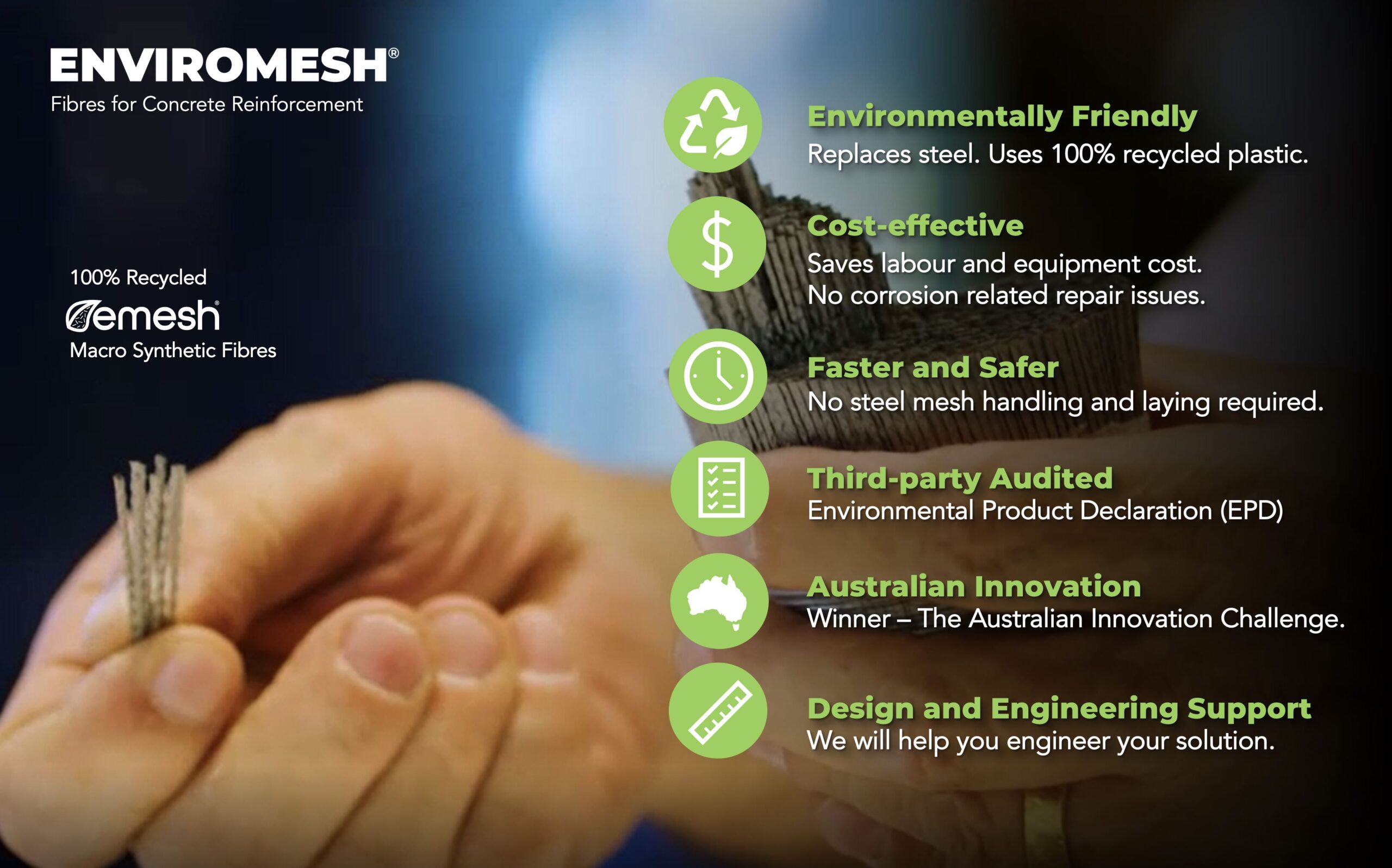
eMesh concrete steel mesh replacement

100% RECYCLED MACRO SYNTHETIC FIBRE CONCRETE MESH

eMesh 100% recycled macro synthetic fibre by Enviromesh, made in Australia, and packaged by National Disability Insurance Scheme (NDIS) workers, was proposed to replace steel mesh reinforcement in the concrete shared user paths (SUPs) and footpaths by North WesternProgram Alliance (NWPA) for the Bell to Moreland Level Crossing Removal Project (B2M LXRP). Reductions in CO2 and PO4 emissions were more than 90% achieved, water and fossil fuel consumption were more than 90% reduced and 200 hours of NDIS employment were created by replacing steel mesh with eMesh, encouraging a deeper examination of other associated benefits, indirect savings and efficiencies of eMesh by NWPA. Areas examined included site activities and compliance, which outlined reduced safety risks on site to workers, time lost due to coordinating, moving and unloading steel mesh deliveries, and reduced pre-pour engineering inspection requirements for eMesh reinforced concrete (no steel mesh to inspect).

The savings across these many areas, which are complemented by site efficiencies and time reduction in construction, provided a clear positive outcome for the decision to adopt the use of eMesh by Major Road Projects Victoria (MRPV) and Rail Projects Victoria (RPV) for future works, with potential for greater improvements across many of the Big Build projects. The potential emission reductions and reuse of waste plastic across future projects, since successful implementation at B2M, is extensive and will provide long term repurposing of a waste stream.

The process to have eMesh approved for use on the B2M project began in late 2019 and early 2020, where, after consultation, design checks, environmental assessment and inspection of existing SUPs at Skeleton Creek (Hobsons Bay, constructed in 2017), a decision was made by NWPA to present a proposal to Metro Trains Melbourne and the Level Crossing Removal Authority for use of eMesh. The proposal was accepted and eMesh was implemented into the project.

Throughout the approval process, which took more than 6 months, and then implementation, there were clear learnings that to introduce a product that is non-standard, the assessment process needs to be clear and concise, backed by evidence and published research. The practical implementation also requires engagement with all levels down to the subcontractor on site. Clear knowledge sharing around how to use, design with and environmentally assess the new product is a key part of success, and B2M showed us this needs to be a strong focus.

For future projects, the engagement of all parties, from concrete suppliers to contractors placing the concrete, is paramount to continued improvement and achieving quality outcomes. Lessons learned are already being implemented across many LXRP, MRPV and RPV projects and will continue to be shared to create continued improvements and quality outcomes.

Membership Rewired

We’re Featured in Infrastructure Magazine (June 2025 Issue) 

We are pleased to share that the Infrastructure Sustainability Council was featured in the June 2025  print edition of Infrastructure Magazine. The article highlights our recently lauxnched member portal as we pivot toward simplicity and stronger member value. 

The article highlights how the new ISC membership offering: 

  • streamlines and segments with simplicity in mind, while still being inclusive of any sized organisation 
  • is designed to help advance the ambitions and objectives of member organisations, and to pro-actively enable collaboration and partnerships 
  • is amplified by the launch of a new member portal to make value more accessible across our members entire organisation.

We thank Infrastructure Magazine for this recognition. Read the full article here

Special Offer for Members of the Infrastructure Sustainability Council! 

All ISC members are entitled to a free digital or print version of Infrastructure Magazine as part of their membership. Register to receive your copy via the ISC member portal here.  

RISE Mentors & Mentees Visits Australia’s First Tunnelling Infrastructure Academy

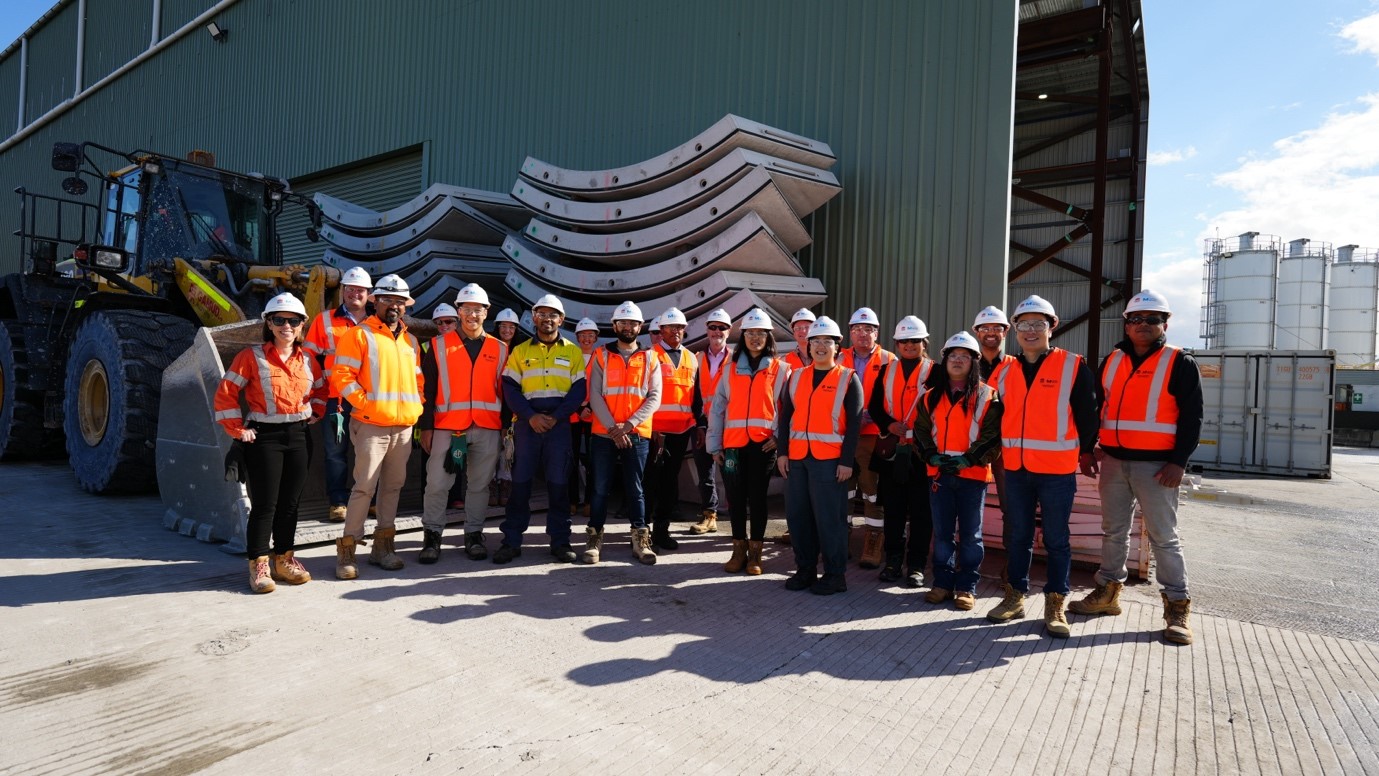
Last month, participants of the Infrastructure Sustainability Council’s RISE mentoring program and local ISAPs were invited to Sydney Metro’sTunnelling Infrastructure Academy (TIA) at Clydean Australianfirst, dedicated tunnel training hub, run by Gamuda as part of the Sydney Metro West – Western Tunnelling Package.

From exploring the spoil shed and conveyor systems to engaging with emerging digital technologies, attendees walked away with invaluable insights into how innovation and capability development are transforming our industry.

This state-of-the-art facility tackles Australia’s construction skills shortage with six practical training zones, featuring:

A refurbished tunnel boring machine (TBM) cabin and partial cutterhead
Conveyor belt, grouting and foaming stations
A virtual reality (VR) simulator room replicating real tunnelling environments

Since its launch, over 670 individuals have enrolled in the tunnelling pre-employment program, embedded within accredited units of competency.

A highlight of the tour was exploring the inner workings of the autonomous and AIassisted TBMs, deployed for the Sydney Metro West Western Tunnelling Package.

These machines use Gamuda’s proprietary AI software to automate steering, thrust, and slurry systems—delivering 8% energy savings over manual TBMs, reducing wear and downtime. The TIA itself is powered by a 240 kWp mobile solar farm—making it one of the largest solar installations on a Sydney Metro site.

Further cementing its pioneering credentials, the Sydney Metro West Western Tunnelling Package received a “Leading” Infrastructure Sustainability (IS) Rating from the Infrastructure Sustainability Council of Australia, and won the Excellence in Social Outcomes award for its TIA initiative.

A massive thank you to Gamuda for their ongoing support of the RISE mentoring program and for opening the doors to such an incredible learning experience. If you’re interested in becoming part of the RISE Mentoring Program in 2026, you can fill out this EOI and you will be notified when applications open.