12 - 2025 - ISCouncil

End of year CEO review: Sustainability and Productivity in Infrastructure

Dear members,

As 2025 draws to a close, it is timely to reflect on the progress and the strains shaping infrastructure across Australia and Aotearoa New Zealand.
This has been a year of sustained delivery pressure across the sector. While investment remained strong across housing, transport, energy, water and social infrastructure, projects continued to face challenges from cost escalation, workforce shortages and market capacity constraints. In this environment, sustainability has become more closely tied to practical outcomes, strengthening funding confidence, supporting productivity, improving long-term asset performance, managing climate risk and lifting whole-of-life value.

2025 brought some turbulent times for sustainability globally. Australia, however, saw continued policy momentum:

  • The release of Australia’s 2035 emissions reduction target
  • The National Climate Risk Assessment and Adaptation Plan,
  • The Australian Sustainability Reporting Standards (ASRS) are coming into effect
  • The launch of the first Australian Sustainable Finance Taxonomy;
  • Australian companies leading in the voluntary adoption of the TNFD, including several ISC members
  • Together, these developments continued to push climate-related strategies, disclosures and nature considerations firmly onto corporate agendas.

In Aotearoa New Zealand, the picture has been more mixed. Key climate targets have been delayed and reporting thresholds significantly raised. At the same time, sustainable finance remains high on the agenda with public consultation on the NZ Sustainable Finance Taxonomy commencing at the end of this year.

In our sector specifically:

  • INSW’s Decarbonising Infrastructure Policy 2025 was complemented with Technical Guidance to standardise methods across projects; and
  • The NSW Government launched their policy to drive digital transformation in infrastructure, both driving progress toward more harmonisation.
  • Infrastructure Australia published the Delivering Net Zero Infrastructure: Workforce Report, highlighting the capacity needs required for lowering emissions in delivering infrastructure.
  • All such actions tie well with Infrastructure Net Zero’s Defining Net Zero, which was published by the ISC and related parties under the Infrastructure Net Zero initiative, now hosted by ASBEC.

For the Infrastructure Sustainability Council, this year has been about delivering tangible outcomes and laying clear foundations for the future. In FY25, we certified 29 “As Built” projects spanning rail, road, energy and water sectors. Together, these projects delivered an estimated emissions reduction of nearly 3.5 million tonnes of CO₂e and approximately A$1.274 billion in avoided costs, representing around 10 per cent of total project capital expenditure.

We also delivered significant upgrades to our tools. The release of the IS v2.2 Design and As-Built tool has improved clarity, flexibility and accessibility, supporting projects of different types and scales to integrate sustainability from early design through to delivery.

One of our most important milestones this year was the launch of Strategy 2030. This sets a clear roadmap for how ISC will support the sector over the next five years, with an expanded focus on delivering across sustainable finance, water, energy and nature-positive infrastructure. As we look ahead, our commitment remains clear:  to enable connected infrastructure that supports people to thrive on a healthy planet.

I thank our you, partners, members and supporters, for the shared commitment, trust and collaboration that continues to make this work possible and impactful.

Best wishes for safe, healthy, and restorative festive seasons!

Toby Kent,
Chief Executive Officer, Infrastructure Sustainability Council
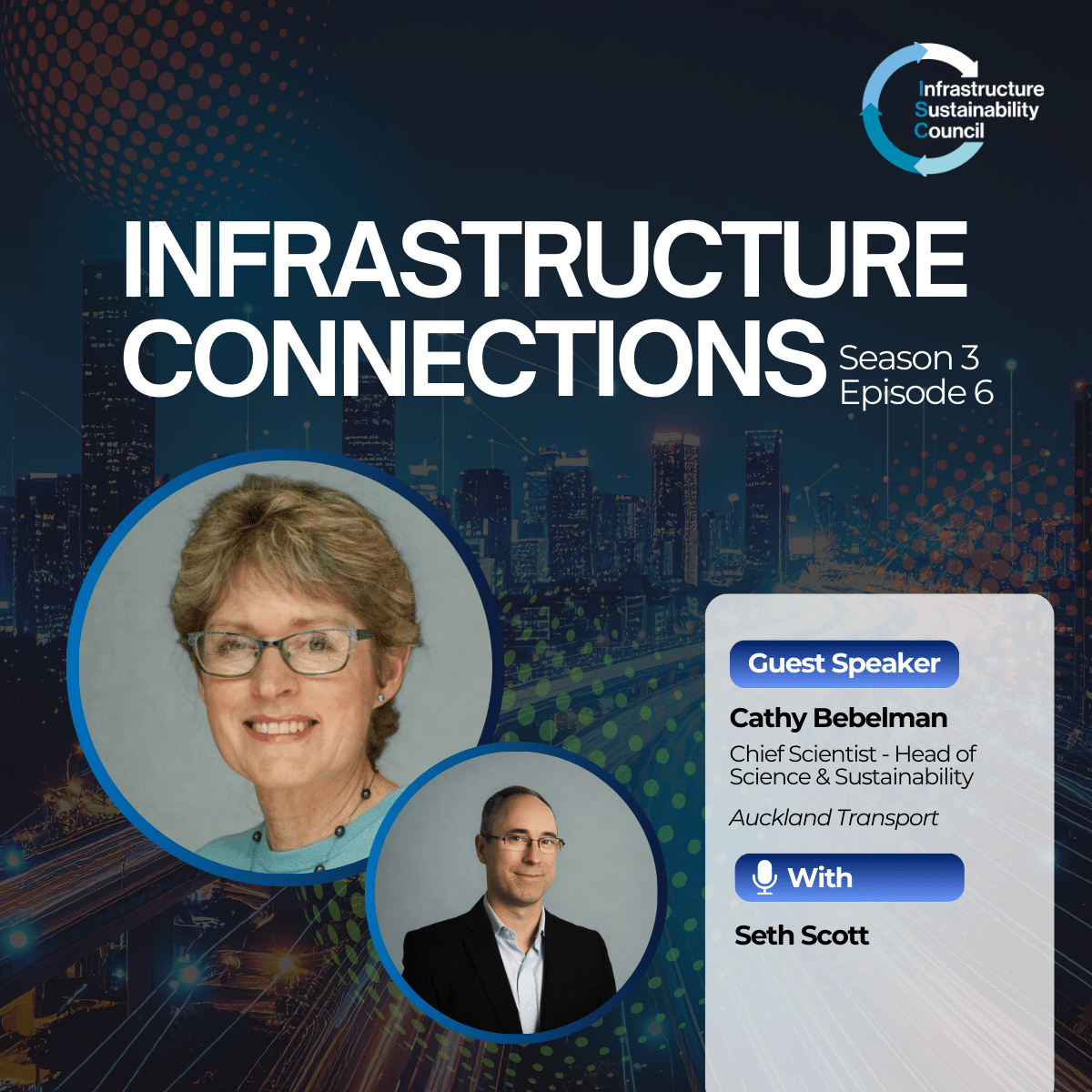
S3E6 – Transport Resilience w/ Cathy Bebelman

Description:

Host Seth Scott interviews Cathy Bebelman. Cathy is the Chief Scientist: Head of Science and Sustainability with Auckland Transport in New Zealand. Cathy has an extensive background in the environmental impacts of infrastructure and transport networks, working as a researcher and consultant in the public sector for over 25 years. She advocates for a holistic approach to the management of climate and the environment.

Auckland Transport made changes to their approach to transport after the 2023 Auckland Anniversary and Cyclone Gabrielle storms. This month they published their Climate Adaptation Framework and Action Plan 2025 found here.

The storms caused 2,000 landslides across the region at a cost to repair of $360 million. Cathy discusses how they worked to resolve this as well as how their budget might need to change to incorporate climate-related storm damage to come.

That hasn’t slowed down AT’s electrification efforts. Aucklanders now enjoy a fully electric train system, the largest electrified bus fleet in the South Pacific, and new electric ferries on the water.

And there’s a lot more to look forward to.

Modern Slavery in Focus: Updates, Risks and Guidance for the Infrastructure Sector

The ISC Modern Slavery Coalition hosted a webinar, providing practical insights and tools to help you manage modern slavery risks effectively.

The webinar launched the ISC Guidance Note – Labour hire in the infrastructure sector – 2025, a useful tool for all members concerned with addressing labour hire-related modern slavery risks in Australia’s infrastructure sector.
Click here for more information on the ISC Modern Slavery Coalition.
Click the link below to access the ISC Guidance note.


2025 ISC AGM reports a year of investment 

The Infrastructure Sustainability Council Annual General Meeting was held on 26 November 2025, bringing members together to reflect on a year of investment, deep engagement and progress toward our purpose to enable connected infrastructure that support people to thrive on a healthy planet.
Despite a challenging operating environment, ISC and its members achieved several important milestones together, including:

  • Sustainability certifications: ISC certified 29 As Built projects across rail, road, energy, and water sectors, achieved significant sustainability outcomes across emissions, energy, water, and waste reductions. Of these, 21 were certified at a Leading or Gold award level, and another 8 at Excellent or Silver level.
  • Environmental impact: Certified projects collectively achieved 76% average emissions avoided; 29% reduction in energy use; 5% reduction in water use (and up to 76% reduction in potable water on some projects); and 95% of waste diverted from landfill.
  • Economic value: Certified projects collectively resulted in $1.274 billion in avoided costs, equating to approximately 10% of total CAPEX.
  • Rating tool improvements: The IS v2.2 Design & As Built Tool was refined to improve clarity, flexibility, and accessibility, particularly for smaller-scale projects under $500 million.
  • Verification model improvements: An in-house quality control function was introduced to create greater certainty and reduced costs for members while maintaining rigorous standards.

These outcomes were shaped directly by member insights and ongoing sector collaboration.

The AGM acknowledged that the financial results for FY25 were impacted by deliberate and strategic investment in new and enhanced ratings and verification tools and services. These investments respond to clear feedback from members and position the organisation for stronger long-term value and impact.

“This year we have been listening to feedback from our members and investing where it counts,” said CEO Toby Kent. “While this has placed short-term pressure on our financial results, it strengthens our ability to deliver what members need in the years ahead.”

Members heard that the organisation will continue building on this year’s momentum, with priorities for next calendar year including:

  • Continuing to enhance and rollout the new IS v2.2 Design & As Built Tool and training
  • Responding to feedback to keep building the member experience
  • Effectively partnering with governments to inform public policy
  • Working closely with the broader infrastructure eco-system to amplify impact
  • Providing unique market insights based on IS Ratings data

Deeper insight to drive sustainable infrastructure outcomes and a stronger collective voice for the sector will be powered by being digital-first, partner-led and people centric.

The Board thanked members for their ongoing support and engagement. Please find linked for your interest the 2025 Impact Report and the 2030 Strategy below.

Navigating Climate Risk – Exploring Climate Risk Scenario Selection for Infrastructure Projects.

In this session, you’ll gain practical insights into:
  • What climate risk assessment means for infrastructure assets and IS Projects (Res-1 credit).
  • Why emissions scenarios matter when planning for future climate risks.
  • The difference between climate scenario frameworks (SSPs vs RCPs) – and why it matters.
  • ISC’s endorsement of SSP3-7.0 as a practical alternative to RCP8.5, and why SSP5-8.5 is not recommended for current assessments.
This is an opportunity for practitioners, project teams, and stakeholders to strengthen their understanding of climate risk and how ISC is guiding best practice in scenario selection.
Speakers
  • Tyrel Momberg – Associate Technical Director, Infrastructure Sustainability Council
  • Amin Niazai – Senior Technical Advisor, Infrastructure Sustainability Council

  • Rebecca Miller – Manager ‑ Sustainable Futures, SMEC
  • Anthony Hume – Associate Director -Sustainability and Resilience, AECOM.

Access presentation slides here

Please view the Navigating Climate Risk Webinar – FAQ Summary here