| Metric | $ Value | Source |
| Costs of Carbon abatement (CCA) | $56 per ton of carbon dioxide | Source: Infrastructure Australia, “Valuing emissions for economic analysis,” February 2024. [Online]. Available: https://www.infrastructureaustralia.gov.au/sites/default/files/2024-05/24IA_Guidance%20note%20-%20Applying%20emissions%20values_1.pdf. |
| Water | $310 per ML of water | Source: Australian Bureau of Statistics, “Water Account, Australia,” 2022. [Online]. Available: https://www.abs.gov.au/statistics/environment/environmental-management/water-account-australia/2021-22. [Accessed May 2025]. |
| Energy – Fuel (Diesel) | 174.27 cents per litre ($0.046 per MJ) | Source: Australian Institute of Petroleum, “National Retail Diesel Prices,” 2025. [Online]. Available: https://www.aip.com.au/pricing/national-retail-diesel-prices. [Accessed May 2025]. |
| Energy – Fuel (Petrol) | 167.45 cents per litre ($0.049 per MJ) | Source: Australian Institute of Petroleum, “National Retail Petrol Prices,” 2025. [Online]. Available: https://www.aip.com.au/pricing/national-retail-petrol-prices. [Accessed May 2025]. |
| Energy – Electricity | $88 per megawatt hour (MWh)
($0.024 per MJ) |
Source: AEMO, “National Electricity Market hits new demand and renewable energy records in December quarter,” 2025. [Online]. Available: https://aemo.com.au/newsroom/media-release/national-electricity-market-hits-new-demand-and-renewable-energy-records-in-december-quarter#:~:text=Wholesale%20electricity%20prices%20averaged%20$88%20per%20megawatt,than%20the%20previous%20quarter%20average%20. [Accessed May 2025]. |
| Waste | $111.4 per tonne
Waste (Spoil) – ‘$ avoided’ Calculation $ avoided from waste diversion are calculated based on how much spoil is diverted from landfill beyond the national average (66%) i.e. Beyond BAU diversion. Example: $ avoided = Total spoil diverted (tonnes) × 31% × Average dollar value per tonne |
Calculated by taking the averages of Metropolitan and Regional Levy across NSW, VIC, QLD, WA and SA.
Source: EPA NSW, “Waste levy areas and levy rates,” 2024. [Online]. Available: https://www.epa.nsw.gov.au/Your-environment/Waste/waste-levy/levy-regulated-area-and-levy-rates. [Accessed May 2025]. |
| Asphalt | $185 per tonne | Source: Pavertrend, “Pavertrend Asphalt / Hot mix Tonnage Calculator,” 2025. [Online]. Available: https://pavertrend.com.au/asphalt/asphalt-calculator?utm_source=chatgpt.com. [Accessed May 2025]. |
| Concrete | $250 per m³ | Calculated by taking the averages of concrete pricing across two sources.
Source: Hipages, “How much is the cost of concrete per m3?,” 2025. [Online]. Available: https://hipages.com.au/article/cost_of_concrete_per_m3?utm_source=chatgpt.com. [Accessed May 2025]. |
| Steel | $2,133 per tonne | Calculated by taking the averages of steel pricing from the source.
Source: NVC Engineering, “Structural Steel Costs in Australia: A Comprehensive Guide,” 2024. [Online]. Available: https://www.nvcengineering.com/post/structural-steel-costs-in-australia-a-comprehensive-guide. [Accessed May 2025]. |
Author: loren.blundell@iscouncil.org
Infrastructure Sustainability Council welcomes Budget first steps but calls for investment and action in infrastructure to reach net zero
The Federal Government’s Budget recognition of infrastructure as a great enabler of social, economic and environmental benefits has been welcomed by Infrastructure Sustainability Council CEO Ainsley Simpson.
Ms Simpson said it was pleasing to see key election commitments honoured, in particular over $8 billion1 in investments in infrastructure, the first $7 billion2 in commitments made through the Rewiring the Nation Fund, $42.6 million for the Climate Change Authority, $500 million to reduce transport emissions, and a total of $1.2 billion3 to 2030 to protect and manage and restore the Great Barrier Reef.
“This Budget represents a sensible first step in addressing climate change, but with only seven years to 2030 and the need to reduce our emissions by at least 43%, its time to make every dollar count,” she said.
“We don’t have any more time to lose.”
While integrated climate, industry and infrastructure policy work is underway, immediate action is needed to deliver wider benefits from the $248 billion infrastructure pipeline4 and avoid locking-in decades-worth of harmful emissions.
“One immediate action would be ensuring wider outcomes and whole-of-life carbon are considered at the business case stage, a step made easier by the inclusion of national targets in the Infrastructure Australia Act in September.”
The Council also called for accountability for all government infrastructure investment to credibly measure what matters. The Infrastructure Sustainability (IS) Rating Scheme was seed-funded and launched in 2012 by the then Minster of Infrastructure & Transport, Anthony Albanese, and is designed to create a common and harmonised approach to advancing the sustainability performance of infrastructure.
“With more than $219 billion in infrastructure assets under IS Rating around Australia, it has become standard practice at a state and territory level to apply the sustainability benchmarking tool to major infrastructure. With the clock ticking, the Federal Government can enable the infrastructure sector to level-up to step-up across the nation.
“Infrastructure plays a critical role in Australia’s path to net zero, with infrastructure influencing 70 per cent of Australia’s emissions.”
The evidence of progress is the 55 percent reduction of lifecycle energy CO2e emissions in 60 projects certified under the Scheme over the past five years. These projects include Paramatta Light Rail, Level Crossing Removal Projects, Western Sydney Airport and South Australia’s North-South Corridor.
“There are many signs we are headed in the right direction – the legislation of the national targets, the focus on green skills as part of the Jobs & Skills summit, and the announcement of a net zero unit in the Department of Infrastructure, Transport, Regional Development, Communications & the Arts, but this just the beginning for long-term impact.
“Collaboration between all levels of government and industry is the most direct path to a thriving nation enabled by resilient, inclusive, net zero infrastructure. We look forward to playing our part,” Ms Simpson said.
-Ends-
For further information please contact us:
T: +61 2 9252 9733
E: info@iscouncil.org
References
1 https://minister.infrastructure.gov.au/c-king/media-release/96-billion-infrastructure-boost-australia
2 https://www.energy.gov.au/news-media/news/rewiring-nation-supports-its-first-two-transmission-projects
3 https://minister.dcceew.gov.au/plibersek/media-releases/joint-media-release-record-budget-boost-protect-great-barrier-reef
4 https://infrastructure.org.au/budget-monitor-2021-22
The 2022 ISC Gala Awards | Media Release

The Infrastructure Sustainability Council (ISC) is proud to announce the winners of the 2022 Gala Awards. This year’s awards will honour excellence in sustainability across environmental, social, governance, and economic quadruple bottom line outcomes, and outstanding contributions to market transformation at organisational, systemic and societal levels.
1. Sustainability Leadership – Excellence in Governance
Recipient: John Holland & Laing O’Rourke Joint Venture
Project: Sydenham Metro Upgrade
Right from the initial planning stages of the Sydenham (Melbourne) Metro Upgrade, the project was underpinned by a comprehensive and robust Sustainability Strategy. This was a deliberate and carefully considered part of John Holland and Laing O’Rourke’s joint venture master plan to mitigate risk and provide a full-bodied governance structure that was present and pragmatic at all levels of the project.
Sustainability Strategy Objectives:
• To identify governing objectives and targets.
• To integrate these objectives and targets into the project’s deed, policies, management plans, sub plans and all subsequent processes, procedures, templates and trackers.
• To overcome issues caused by interfacing between multiple participants (stakeholders such as Sydney Water, Sydney Trains, ARTC, Sydney Metro, Transport for NSW, Inner West Council; multidisciplinary design and site teams; and suppliers and contractors) with different priorities.
• To create a working environment where the strategy objectives flowed throughout all the teams involved, so that all individuals and stakeholders were empowered to find ways to work better.
Sustainability Strategy Outcomes:
• The saving of over 15,420 tonnes of aggregates, over 1140 tonnes of asphalt, over 4,480m3 of poured concrete and over 784 tonnes of steel reinforcement.
• A massive reduction in waste, compared to past projects.
• More than a 3,460-tonne reduction in carbon emissions.
The project’s legacy is not just about environmental sustainability. It’s also about the influence of a governance structure that doesn’t just give permission to question the status quo, but actively encourages that questioning.
2. Sustainability Leadership – Excellence in Economic
Recipient: Acciona Samsung Bouygues Joint Venture
Project: M4-M5 Link Tunnels
After extensive research and development with the supply chain that took more than a year, the Acciona Samsung Bouygues Joint Venture developed a world first shotcrete application process for the lining of the M4-M5 Link Tunnels in Sydney. This process included creating an innovative shotcrete design mix as well as improving techniques to apply shotcrete to the tunnel walls in order to reduce rebounding.
Tunnel Lining Objectives
• To develop a new offering for this and future projects that use shotcrete for tunnel lining. Future tunnel projects will be able to capitalise on the sustainability benefits of a proven high-performance shotcrete and incorporate it into their own tunnel design.
• To provide pathways for future collaboration with stakeholders (supply chain, designers, construction team and independent certifiers) to conduct research and development, to show proof of concepts, and to address engineering challenges with substantial sustainability benefits on upcoming infrastructure projects.
Tunnel Lining Outcomes
• A reduction of more than 33,000 (t CO2-e) of embodied carbon. This in turn has reduced the amount of shotcrete used on the project by 27,000m3 (15%) and reinforced steel fibres by 830 tonnes (10%).
• The removal of 9,000 heavy vehicle movements off Sydney local and main roads.
• Demonstrated cost savings of $11,000,000 to the project by minimising materials through the application of innovative high-performance shotcrete.
• A permanent shift in the supply chain for how future tunnel projects will be designed and constructed.
The legacy of the high-performance shotcrete used for the lining of the M4-M5 Link Tunnels is a design mix that has allowed the M4-M5 Link Tunnels project to reduce the thickness of the lining of the tunnels by 15%. It is expected that this design mix will be business as usual for future road tunnel projects that require shotcrete for tunnel linings.
3. Sustainability Leadership – Excellence in Social
Recipient: McConnell Dowell
Project: The Echuca-Moama Bridge Project Stage 3
During Stage 3 of the $323.7m Echuca-Moama Bridge Project, Major Road Projects Victoria and its construction partner, McConnell Dowell, teamed up with local disability support service provider Vivid. This partnership gave 23 young adults, living with disability, an opportunity to be part of a dynamic and inclusive workplace. They were tasked with cleaning and maintenance roles at the project site offices in both Victoria and New South Wales.
Disability Employee Objectives
• To provide young local people with paid and meaningful employment in a supported environment.
• To generate significant Aboriginal employment outcomes and exceed the Aboriginal employment target.
• To support Aboriginal owned businesses by spending a significant percentage of the total contract value with those businesses.
Disability Employee Outcomes
• By the Project’s completion in early 2022, the Vivid supported employees had collectively contributed around 20,000 work hours to the Project, an experience that has substantially improved their access to a myriad of work tasks and boosted their levels of self-confidence and interpersonal skills.
• Nine of the supported employees seized the opportunity offered by the Project to further expand their skills by undertaking and completing a Certificate II in Cleaning Operations at Bendigo TAFE’s Echuca campus.
• Of the nine Vivid graduates, four are now in mainstream permanent part-time employment, and one has applied for open employment through a traineeship.
Due to the increased income generated by the Project’s procurement contract to fill cleaning and maintenance roles, Vivid has been able to upgrade areas of its business that do not attract direct funding. This has improved its ability to support the employment pathways of local people living with a disability.
4. Sustainability Leadership – Excellence in Environmental
Recipient: John Holland & Laing O’Rourke Joint Venture
Project: Sydenham Metro Upgrade
During the Sydenham Metro Upgrade, the joint venture team of John Holland and Laing O’Rourke closely collaborated with stakeholders on a sustainability-centred design approach. The value of this approach was demonstrated when design adjustments were made that led to excellent environmental, societal and economic outcomes.
Sustainability-centred Design Objectives
• To conduct analyses of drainage models and patterns in order to discover how the model might be effectively revised.
• To downsize parts of the infrastructure and reduce material usage by changing the original design of the aqueduct from four cells wide to three cells wide.
• To preserve and upgrade, rather than replace, a Heritage listed pumphouse.
Sustainability-centred Design Outcomes
• The reduction in width of the aqueduct led not only to significant reductions in materials for the aqueduct, but also for the access ramps, culverts, transition chambers and substructures.
o The transitions from the culvert to the aqueduct were reduced in size from 18 metres in width to 13.2 metres.
o The transitions chamber was originally one large structure, but was optimised to become two smaller structures that attached to each culvert.
o Instead of having three larger diameter pipes, the opportunity was identified to instead utilise four smaller diameter pipes in the middle section of the aqueduct and three smaller diameter pipes at either end.
• There was a total saving of 7,500 TCO2e and a total material lifecycle reduction of 40%. There were considerable savings in construction costs and demolition waste and energy reductions, due to less materials and equipment required for construction.
The most powerful legacy of the project was the recognition of the necessity and value of thought leadership from those within the construction and engineering space. Designing with sustainability as the core focus empowers experienced minds in the industry to challenge the status quo.
Without input from the project team, and without the vital analyses of flow rates, ground conditions, and drainage models, the original design would have been accepted and all opportunity for economic, material, societal and environmental savings would have been lost.
5. Industry Impact – Private Sector, Large
Recipient: Acciona
As a sustainable solutions business, Acciona recognises that the impact of climate change is endangering every facet of the natural and physical world. Acciona asserts that changing course in order to realise a sustainable, liveable future for all requires an immediate, ambitious and concerted effort, and Acciona’s Sustainability Master Plan (SMP) 2025 is its contribution to that effort.
Sustainability Master Plan 2025 Objectives
• To accelerate the response to the climate change emergency.
• To provide a roadmap to moving beyond a sustainably responsible and resilient business to a business which embraces and promotes our Regenerative Vision and transition towards a decarbonised economy.
• To pursue 100% renewable electricity on new tenders from July 2022.
• To continue to be carbon neutral (Acciona is the only construction company in the sector to be carbon neutral, and has been globally since 2016).
Sustainability Master Plan 2025 Outcomes
• Recognised as a sustainability leader by the world’s top sustainability indexes and rating schemes.
• An active and engaged employee base, with sustainability advocates now embedded across multiple reporting roles within the business.
• Secured €3.3 billion in sustainable financing, driving business and project sustainability performance.
• Acciona’s dedicated Decarbonisation Fund supports and fosters innovation, leading to low-carbon solutions.
Acciona is contributing positively to the climate emergency and a sustainable future for all through its approach to decarbonisation. Its approach, driven by the SMP2025, is inspiring other companies to follow its lead.
6. Industry Impact – Private Sector, Small
Recipient: Earth Friendly Concrete Pty Ltd – Wagners
Through its ultra-low carbon technology, Wagners has developed and branded Earth Friendly Concrete® (EFC). This enables concrete producers to eliminate cement from concrete, thereby reducing the carbon footprint in the built environment.
Earth Friendly Concrete Objectives
• To align with United Nations Sustainability Goals (currently 9 in total).
• To support the circular economy.
• To disrupt current old-world standards and specifications.
• To encourage cement producers to combine Wagners proprietary EFC Activator Solution and admixtures with materials from their existing suppliers of aggregates and SCM’s.
Earth Friendly Concrete Outcomes
• Through a range of strategies, Wagners has reduced the embodied carbon of Earth Friendly Concrete from an average 120kg of co2/m3 to an average 90kg of CO2/m3, without the need for any offsets.
• During the last 18 months, Wagners eliminated 1,481.6t of CO2 and 2,043.6t of virgin raw materials from innovative infrastructure projects.
EFC is the lowest embodied carbon concrete available on the market, and is now being used on a range of infrastructure projects. When used at scale, it makes a significant dent in man-made carbon emissions.
7. Industry Impact – Public Sector
Recipient: Main Roads Western Australia
Main Roads Western Australia has made a strong contribution to circular economy industry impact by delivering infrastructure projects that are promoting social and organisational change at a strategic level.
Circular Economy Objectives
• To facilitate systemic change through policies and standards.
• To increase Aboriginal engagement and participation by awarding $700 million worth of contracts and 3.5 million work hours to Aboriginal businesses and people over the next five years.
Circular Economy Outcomes
• Over the past 12 months, Main Roads Western Australia spent $97.9million on Aboriginal businesses, equating to 586,700 work hours; and
• The use of crushed recycled concrete was increased to over 117,000 tonnes.
Main Roads Western Australia is committed to contributing to the circular economy in WA, including doubling the broader ongoing use of Roads to Reuse Crushed Recycled Concrete to beyond 200,000 tonnes, and continuing to drive the use of locally produced crumb rubber.
8. Individual Contribution to a Sustainable Future – Emerging Leader
Recipient: Sam Donaldson
Sam Donaldson has been motivated to make sustainability in construction a reality throughout his entire career. An important milestone for Sam was his appointment to his current position as Hub Sustainability Leader at Laing O’Rourke. He had a vital role in the development of their Global Sustainability Strategy – to ensure the unique factors associated with operating in Australia were considered and prioritised. This strategy has not only caused a cultural shift within the organisation, but also in the construction sector more broadly.
With regard to IS ratings, Sam has achieved some of the highest results for complex major infrastructure projects and has received multiple IS awards for delivering positive organisational change and exemplar outcomes. He has also put a decision-making framework in place to ensure consistency and ethics across the organisation, including the rejection of projects considered unacceptable in terms of future emissions, such as thermal coal projects.
As an ambassador to the organisation’s STEM+ program, he helped design and deliver a sustainability module. From the Laing O’Rourke Graduate Development Program, he created a dedicated rotation of young professionals into sustainability roles. And for the organisation’s leaders, he helped design, with Cambridge University, a key strategic leadership program around maximising innovation and value creation through sustainable solutions.
On a personal note, Sam’s home town of Ocean Shores on the NSW North Coast was significantly impacted by the 2021 floods. Houses and infrastructure were damaged. Families and friends were displaced. These events strengthened Sam’s commitment to effect change.
‘It made me realise that time is not on our side. We are seeing a different world in recent times. It’s only going to get worse unless we all pick up the pace and inspire more of our people, and more of our industry, towards sustainability in construction.’
9. Individual Contribution to a Sustainable Future – Sustainability Champion
Recipient: Georgia Gosse
Georgia Gosse is currently the Infrastructure Advisory Principal and Queensland Regional Service Group Leader with Aurecon. Before joining Aurecon in 2022, Georgia served as the sustainability manager for Australia’s national freight network, Inland Rail, for four years.
During her tenure at Inland Rail, Gosse established a strong sustainability culture by implementing environmental and sustainability policies, strategies, systems, and processes, and by running events. One of her most notable contributions was the installation of carbon-neutral precast culverts for Inland Rail that delivered a reduction of 7,250 tonnes of carbon in the project. This is equivalent to removing 350 cars from the road for a year.
Georgia drives positive change in the infrastructure industry by sharing her knowledge and inspiring more women to pursue careers and make their marks in the industry. She is a sought-after speaker at industry conferences and events, where she advocates for sustainability within the infrastructure industry.
She is an integral member of the Australasian Railway Association’s (ARA) Sustainability Committee and was closely involved in the development of the ARA’s sustainability strategy and the launch of their first sustainability conference. She mentors emerging and aspiring sustainability leaders through her involvement in the ARA’s Women in Rail Mentoring Program, which aims to help women working in rail develop their leadership capabilities, and in the Grandshake Program, which aims to help high school students explore and understand different career opportunities.
‘The younger generation tell me they want to do work with a purpose and to feel like they are contributing to the greater good. The infrastructure industry needs more passionate people who are driven to contribute to the fabric of our society. There is an obvious alignment and the promotion and increased visibility of sustainability in infrastructure projects will help attract the future generation to the infrastructure industry.’
10. Individual Contribution to a Sustainable Future – Enduring Impact
Recipient: Andrew Ackerman
Andrew Ackerman, the Alliance General Manager of the South Eastern Program Alliance (SEPA), has long been a sustainability champion in the construction industry.
For Andrew, having sustainability as a core focus has been at the forefront of what he has been doing for over two decades. Bur for change to occur, people need to feel safe to suggest, experiment with and create change. Not only has Andrew crafted an environment in which project teams feels safe to discuss sustainability innovations, he has insisted on it.
Andrew’s work and influence have contributed to many and varied improvements in construction, design, team culture and performance, and in sustainable materials, construction practices and solutions. They range from small details to major, industry-wide shifts.
Not only has Andrew been leading the way in making construction and engineering more sustainable from an emissions standpoint, he is also a passionate believer in advancing the full spectrum of sustainability, including diversity, inclusion, safety and wellbeing.
He has recently focused on ensuring construction project staff have a five-day working week for better work/life balance, more positive mental health results, better site safety and stronger talent attraction. Andrew hopes his legacy is ensuring we future proof our business and our industry.
People in construction often ask Andrew where they should start when it comes to sustainability.
‘You start with the things you can do differently right now. The starting point for us in our SEPA sustainability strategy was thinking about the things that we could influence from day one. That was very much about our site establishment and making a commitment to net-zero site emissions for all our new sites across SEPA.’
Outstanding Achievement – IS Rating Scheme Awards
The Infrastructure Sustainability Council’s IS Rating Scheme (IS) is Australia and New Zealand’s only comprehensive rating system for evaluating economic, social and environmental performance of infrastructure across the planning, design, construction and operational phases of infrastructure assets.
We would like to congratulate the following award winners for outstanding achievement in IS As Built, Design and Planning:
Outstanding Achievement – IS As Built (v1.2)
Project: LXRP NWPA – Bell to Moreland
Recipient: Level Crossing Removal Project, North Western Program Alliance (Level Crossing Removal Project, John Holland, KBR & Metro Trains Melbourne)
Outstanding Achievement – IS As Built (v2.0 and 2.1)
Project: North-South Corridor – Regency Road to Pym St v2.0
Recipient: South Australia Department of Planning, Transport, and Infrastructure, Mott MacDonald, McConnell Dowell
Outstanding Achievement – IS Design (v1.2)
Project: LXRP SPA – Additional Works Package 2 (AWP2)
Recipient: Level Crossing Removal Project, Southern Program Alliance (Acciona, Coleman Rail, Level Crossing Removal Project & Metro Trains Melbourne)
Outstanding Achievement – IS Design (v2.0 and 2.1)
Project: Armadale Road to North Lake Road Bridge Project
Recipient: Main Roads Western Australia, Laing O’Rourke, BG&E
Outstanding Achievement – IS Planning
Project: Bunbury Outer Ring Road
Recipient: Main Roads Western Australia
IS Ratings for Infrastructure Sustainability and ESG Assurance

The IS Rating Scheme (IS) is a voluntary third party assured standard that evaluates the governance, economic, environmental and social performance of infrastructure assets. The IS rating system enables evaluating sustainability across the planning, design, construction and operational phases of infrastructure programs, projects, networks and assets.
In this webinar we will cover how IS rating tools
• enable financial institutions to integrate sustainability / ESG into the investment decision-making process for new or existing infrastructure projects and portfolios,
• provide measurement benchmarks and minimum standards for new and existing assets to become more climate change resilient and socially responsible,
• are used by financial institutions to structure ESG products such as sustainability linked loans (with case studies)
Digital tool receives support to deliver decarbonisation of construction and infrastructure in Aotearoa
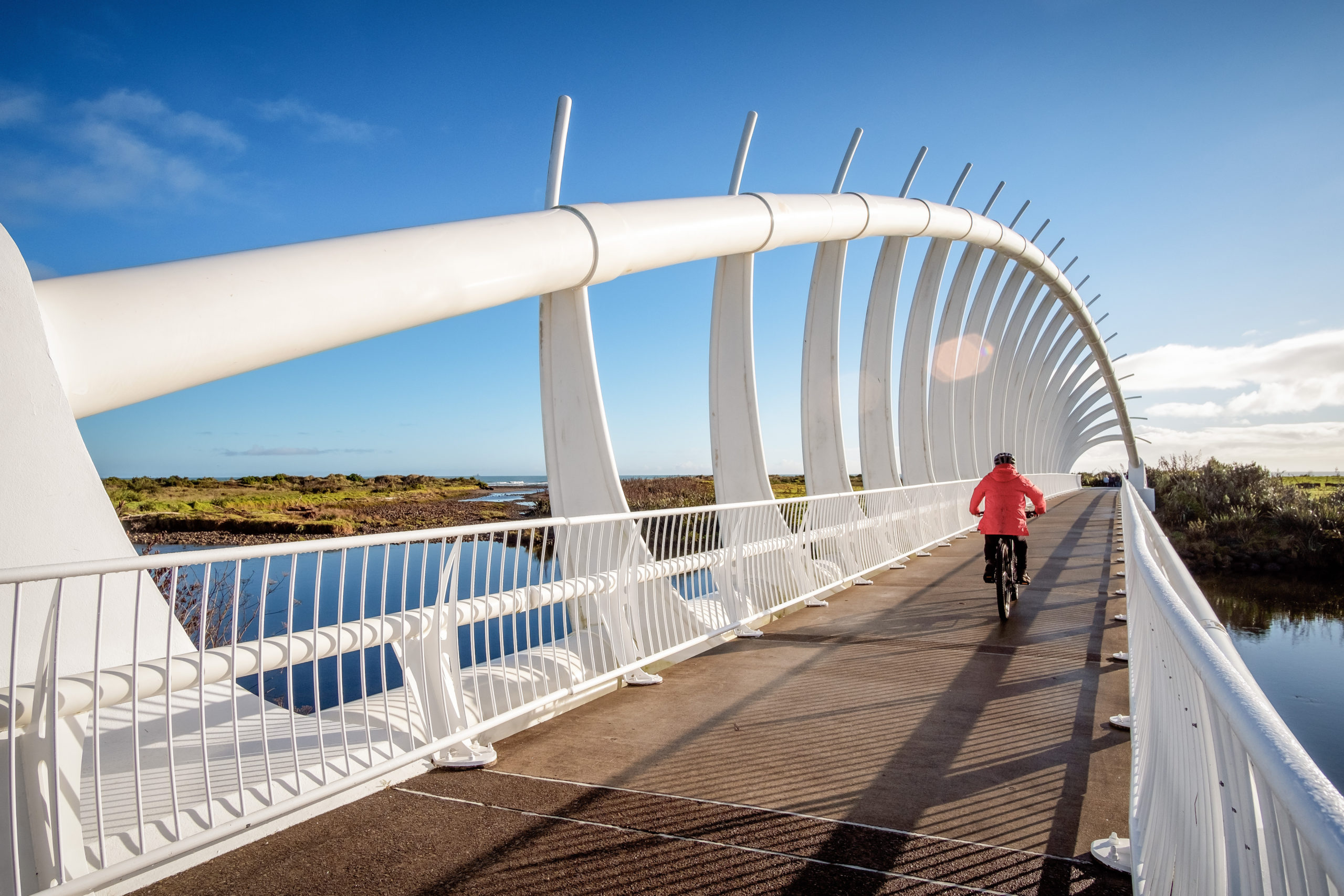
A brand-new digital tool will drive a sector-wide shift in the decarbonisation of Aotearoa’s infrastructure.
The Westpac NZ Government Innovation fund has today announced an investment in the Infrastructure Sustainability Council to scale decarbonisation and sustainability outcomes in Aotearoa infrastructure. Specifically streamlined for infrastructure programmes and projects with a capital investment less than $100m, IS Essentials will be an online version of the Infrastructure Sustainability Council’s Infrastructure Sustainability (IS) Rating Scheme.
The IS Rating Scheme enables government agencies, private asset owners, and investors to measure, improve, and report on the economic, environmental, cultural, and social impact of infrastructure investments. This includes transport, water and energy infrastructure assets, ports, parks, and community facilities throughout Aotearoa.
The investment from the Westpac NZ Government Innovation Fund comes under their seventh intake focusing on Financing and Incentivising the Decarbonisation of Aotearoa.
Infrastructure and construction have been identified as significant contributors to decarbonisation efforts in Aotearoa, contributing up to 20% of New Zealand’s carbon emissions. The IS Rating Scheme is the only globally recognised sustainability standard that covers all stages of the asset lifecycle for all types of infrastructure and is aligned with the UN Sustainable Development Goals and NZ Treasury’s Living Standards Framework.
“This is a powerful symbol of progress towards sustainable infrastructure in Aotearoa New Zealand,” says the Council’s CEO Ainsley Simpson.
“The Rating Scheme creates impact by measuring what matters, identifying opportunities for the sector to drive changes that will have the biggest impact on emissions over an assets lifecycle.
“With IS Essentials, sustainability can be embedded into decision making to deliver better outcomes for our environment and communities.
Infrastructure projects rated under the Scheme are set to deliver up to NZ$2.6 return per $1 spent, through improved materials, energy emissions, environmental, social and cultural outcomes.
Currently, more than 220 infrastructure assets across New Zealand and Australia are under rating, with a total combined capital value of over $219B. In 2021, the Council certified a 56% reduction in lifecycle materials emissions and a 46% reduction in lifecycle energy emissions when compared to standard practice.
It is estimated that 80% of New Zealand’s publicly funded infrastructure projects have a capital value under $100m. The new tool is intended to make the Rating Scheme accessible to a wider range of projects across central and local government and as well as private infrastructure developments.
There is a strong demand in New Zealand for sustainability benchmarking that is accessible, scalable and cost-effective, according to ISC’s New Zealand General Manager, Adrienne Miller.
“Government, private asset owners, financial and investment sectors are all looking for sustainability assurance to better deliver and report on their own sustainability achievements, and it needs to be transparent, robust and comprehensive.
Director of the Westpac NZ Government Innovation Fund Simon Rogerson believes that being able to qualify the performance of more infrastructure projects is key to creating a more sustainable New Zealand.
“Aotearoa needs collective action to create a more sustainable future. By making the IS Rating Scheme relative to a New Zealand environment and accessible to smaller infrastructure projects, Infrastructure Sustainability Council will enable more projects to meet their sustainable infrastructure goals, which will have wide reaching benefits, says Mr Rogerson.
The IS Essentials tool is in pilot phase with 18 projects in Australia and New Zealand signed up to date. Asset owners are invited to contact Ms Miller, General Manager NZ to express interest in being included in the pilot.
“We believe the things we do today should lead to a positive future. Every infrastructure asset is an opportunity to do things better says Ms Simpson.
About Infrastructure Sustainability Council
The Infrastructure Sustainability Council (IS Council) is purpose-led not-for-profit operating in Australia and Aotearoa New Zealand. ISC works with its members to ensure that all infrastructure delivers social, cultural, environmental, and economic benefits. The Council works with more than 20 federal, state and local government departments. The Infrastructure Sustainability (IS) Rating Scheme is mandated by delivery agencies and asset operators across Australia and New Zealand with more than $200 billion infrastructure projects undertaking ratings. The Council represents 200-plus individual companies, departments and associations with a combined annual turnover of more than $50 billion. For more information, contact the IS Council on info@iscouncil.org or visit www.iscouncil.org
About the Westpac NZ Government Innovation Fund:
The Westpac NZ Government Innovation Fund is a joint initiative established in 2016. Funded by Westpac NZ and is mutually governed by Westpac NZ and the New Zealand Government, its aim is to drive innovation and change at a government level to solve real-world issues and help create solutions that are tangible, valuable, and inspiring for all New Zealanders.
We listen to those who want to make a difference – government agencies, organisations, business or everyday New Zealanders who have identified a problem worth solving – and provide funding and expertise to explore, validate, or implement smart solutions. We help connect potential partners and customers in the government and private sector, bringing people together with shared problems or experiences.
Media contacts:
Infrastructure Sustainability Council
Adrienne L. Miller, General Manager New Zealand
M 027 693 9753 | E Adrienne.Miller@iscouncil.org
Westpac NZ Government Innovation Fund
Annabel Olsen, Westpac NZ Media Relations Adviser
M: 027 809 3477 | E: annabel.olsen@westpac.co.nz
Journey to Net Zero
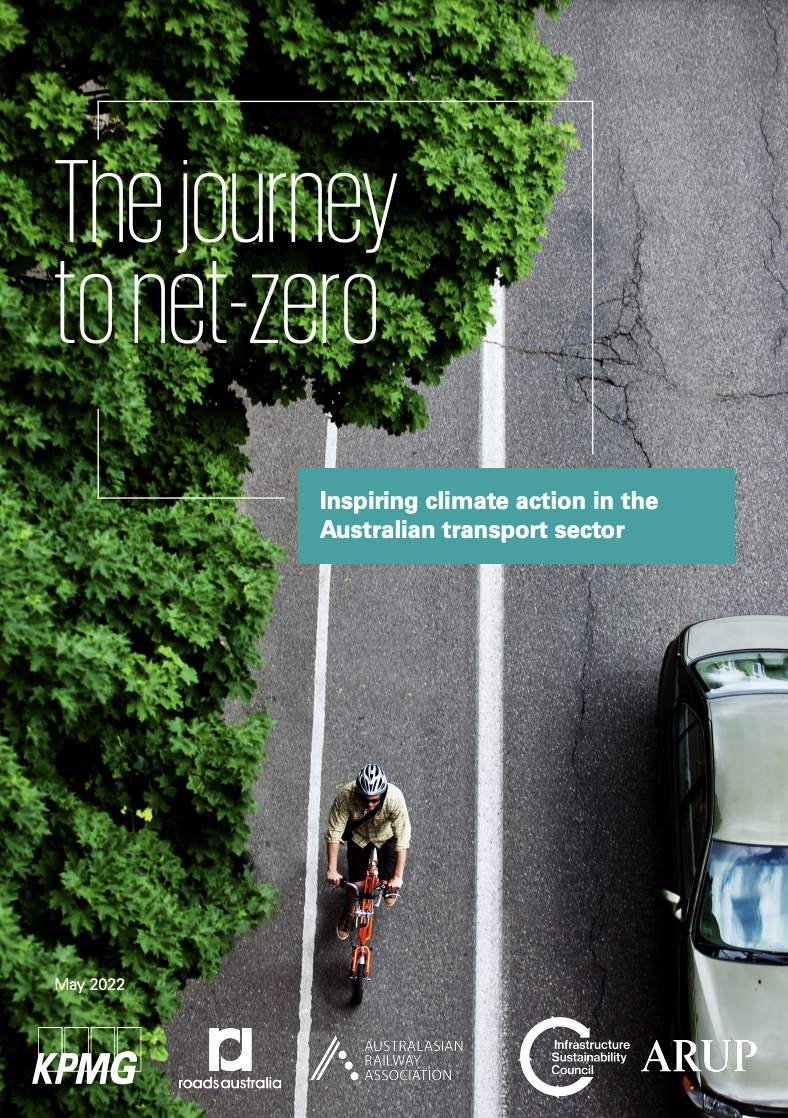
New report to drive action on transport’s journey to net-zero.
Three infrastructure peak bodies have issued a new report today to call for industry transformation to accelerate the transport sector’s journey to net-zero and support Australia’s sustainable future.
The Journey to Net Zero – Inspiring Climate Action in the Australian Transport Sector was delivered as part of an industry-first partnership between the Australasian Railway Association (ARA), Infrastructure Sustainability Council (ISC) and Roads Australia (RA), and includes 46 recommendations to accelerate decarbonisation in the sector.
The report, authored by KPMG and sponsored by Arup, analysed local and global examples of leading best practice, and features 29 case studies demonstrating existing technology and strategies for carbon reduction.
The report sets out a series of actions for government and industry to support a focus on place making, drive emissions reduction, support investment in renewables and innovation, and promote engagement and collaboration.
In Australia, 70 per cent of greenhouse gas emissions are attributable to, or influenced by infrastructure.
Once operational, 55 per cent of Australia’s annual emissions are related to the uses they enable. Australia’s National Greenhouse Gas Inventory estimates that the transport sector contributed to 18.3 per cent of Australia’s emissions in 2020 (94 MtCO2e) and is projected to increase to 100 MtCO2e by 2030.
The project partners confirmed collaboration would be crucial to transforming our transport systems to drive action in the sector.
ARA Chief Executive Officer Caroline Wilkie said the transport sector would play a critical role in achieving net-zero targets.
“Transport systems shape how we live and work and will be a critical part of our sustainable development,” Ms Wilkie said.
“This report confirms the transport sector will be a key role in leading Australia’s journey to net-zero.”
RA Chief Executive Officer Michael Kilgariff said the report highlighted the industry’s commitment to support action on climate change.
“This report is a powerful demonstration of industry’s willingness to step up and play its part in driving change,” Mr Kilgariff said.
“The collaboration between our organisations sends a powerful signal that all transport modes have a responsibility to deliver enhanced sustainability outcomes – and we will only achieve those by working together.”
ISC Chief Executive Officer Ainsley Simpson said there are many solutions available to us now to reduce emissions.
“This report confirms that with a national plan we can accelerate short term action for positive long-term change.” Ms Simpson said.
“Yes, there is work to be done using levers like policy, investment and innovation, but there is so much we amplify right now including measuring and transparently reporting our progress toward net zero.”
Kerryn Coker, Arup Co-Chair in Australasia said Arup is pleased to support Australia’s transport sector in scaling-up current sustainability initiatives and implementing new ones.
“We see multiple opportunities for positive change through a combination of existing and new technology,” said Ms Coker.
“Governments can make significant impact through policies, and as major transport infrastructure and service providers – influencing low carbon investment choices across construction, manufacturing, fuels, operations, maintenance and decommissioning. We see this report as a catalyst for more sustainable public and private transport ecosystems with enduring social benefits.”
The report identified five key areas of action to drive action and support the sector’s journey to net-zero:
1. Create a national, strategic approach to transport and infrastructure, with a focus on placemaking to meet the community’s long-term needs
2. Introduce policies and investment that promote the development of efficient, sustainable and resilient transport systems, including a move to ensure all new infrastructure projects incorporate net zero emissions targets
3. Enable collaboration, capacity building and education at all stages of the process and advocate for new approaches to procurement
4. Implement governance structures, processes and approaches to drive transparency and sound decision making to support the decarbonisation of transport systems
5. Adopt and promote technology solutions that optimise asset design, construction and operation of road and rail fleets
The report will be launched at an event in Sydney today, supported by launch event partners ACCIONA and Autodesk. The ARA, RA and ISC are also set to embark on further government and industry engagement to act on its findings and recommendations.
The ARA, RA and ISC thanks Arup for their support for the project as the report sponsor.
An embargoed copy of The Journey to Net-Zero is available here.
Note to editors: The Journey to Net Zero – Inspiring Climate Action in the Australian Transport Sector will be launched at a lunch event at the Sydney Cricket Ground, Sydney from 12-2.30pm today. Caroline Wilkie, Michael Kilgariff and Ainsley Simpson will be available from 11am for interview.
Further information:
Simon Morgan, Director Corporate Affairs – Roads Australia – 0403 477 131
Joeley Pettit, Director, Corporate Services and Corporate Affairs – Australasian Railway Association – 0407 061 421
Laura Harkins-Small, General Manager, Advocacy – Infrastructure Sustainability Council – 0423 058 183
Journey to Net Zero
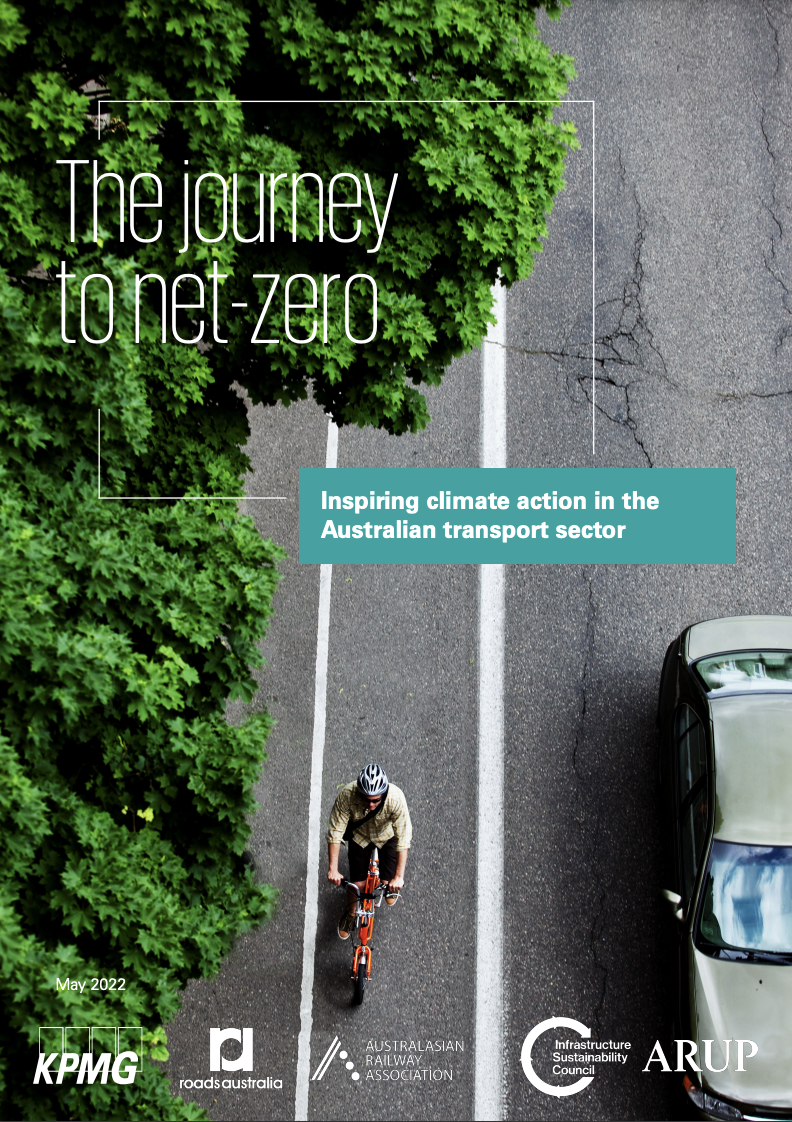
A journey to net zero presents a compelling case for a great opportunity to change the way we approach out transport sector, and indeed our towns and communities. It is a ‘call to action’ for the industry to stop and rethink the way we approach transport in Australia. It presents an opportunity for the industry to come together to collaborate, ideate and explore new methods, approaches, and tools to improve the impact our industry has on society, the environment, our culture, and climate.
Delivered as part of an industry-first partnership between the Australasian Railway Association (ARA), Infrastructure Sustainability Council (ISC) and Roads Australia (RA) and includes 46 recommendations to accelerate decarbonisation in the sector. Authored by KPMG and sponsored by Arup, the report analysed local and global examples of leading best practice and features 29 case studies demonstrating existing technology and strategies for carbon reduction.
The report identified five key areas of action to drive action and support the sector’s journey to net-zero:
- Create a national, strategic approach to transport and infrastructure, with a focus on placemaking to meet the community’s long-term needs
- Introduce policies and investment that promote the development of efficient, sustainable, and resilient transport systems, including a move to ensure all new infrastructure projects incorporate net zero emissions targets
- Enable collaboration, capacity building and education at all stages of the process and advocate for new approaches to procurement
- Implement governance structures, processes and approaches to drive transparency and sound decision making to support the decarbonisation of transport systems
- Adopt and promote technology solutions that optimise asset design, construction and operation of road and rail fleets
Simon Morgan, Director Corporate Affairs – Roads Australia – 0403 477 131
Joeley Pettit, Director, Corporate Services and Corporate Affairs – Australasian Railway Association – 0407 061 421
Laura Harkins-Small, General Manager, Advocacy – Infrastructure Sustainability Council – 0423 058 183
Thriving Nations Report
From the moment we wake to the moment we go to sleep, what we do and how we do it, is enabled by our infrastructure.
It is crystal clear, this century is one of change – for our lifestyles, our communities, our economies and our environment. Whether it is climate change, addressing inequality or riding the wave of the technology disruption, we will no longer be able to take our way of life for granted or ask the planet and people to bear the cost of doing things the same way that we always have. Delivery of a positive future for people, planet and the economy will not happen by accident. It is only possible through proactive, coordinated and collaborative action by people, for people. Infrastructure is going to be instrumental in building resilience and helping us drive and reinforce positive change. The infrastructure we plan, build and operate today will be the difference between surviving and thriving; now and for generations to come.
This challenge needs to seen, and seized by a world-class infrastructure sector. We have crossed the chasm, and sustainability is no longer peripheral and localised; now it is becoming democratised and globalised. It is becoming competitive advantage, core business, and unlocking new markets. Sustainability, ESG, is yet to fully unleash as a catalyst for market transformation. As this happens, our sector will find its purpose; enabling people, places and planet to thrive.
How? By delivering infrastructure for people, by people. Together with our partners Urbis, we’ve explored the relationship between world class infrastructure and thriving nations, and mapped new opportunities that deliver investment returns for all beneficiaries, ecosystems, communities and economies. It will take foresight and increased interconnection; and a sectoral culture that is underpinned by action that is resourceful, resilient and responsible. Together let’s create a legacy our people are proud of.
Place-based approach to net zero
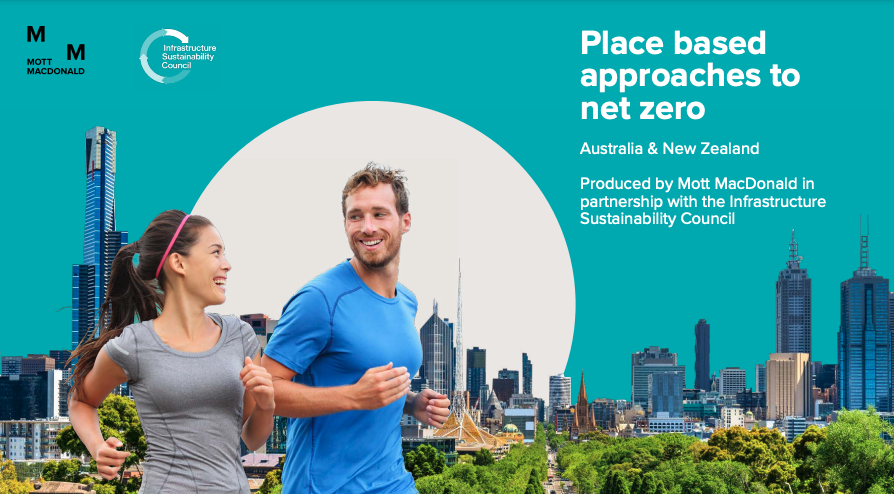
A place based approach acknowledges that the implementation of net zero commitments and goals will be more successful if the solutions both relate to the unique context in which they are applied, and mobilise localised resources, action and engagement.
Place based solutions to net zero provide multiple benefits such as:
- Mobilising enthusiastic local investment and resources on locally applicable solutions that are not otherwise visible to the market, thus accelerating much needed scale-up of net zero solutions.
- Accelerating community buy-in to the lifestyle changes needed, through an understanding of local concerns and motivations.
- Increasing the opportunity and likelihood of success to achieve net zero mandates.
The need for local action
All branches of government have critical roles to play in the success of a net zero future in Australia and New Zealand. With mandates across government and major centres of production and consumption, an estimated 70% of Australia’s carbon emissions come from the infrastructure sector. Many tiers of government are already committed to a place based approach – we need to leverage this to make sure that local governments and communities have the power to directly influence many of these emissions.
A systems approach
Implementing net zero solutions in the infrastructure sector is complex. When change is needed, especially on the scale required to achieve net zero, a systems approach that looks at the interconnectedness of infrastructure rather than at the sector and sub-sectors in isolation, has the potential to unlock barriers.
The business case
A local systems approach can derive previously untapped value by capitalising on co-benefits that are only visible or implementable at a local level, but generate resilience across the whole system. This kind of approach can reduce the overall whole-life cost. Treating a community or urban centre as a system-of-systems can help authorities understand where potential points of failure exist and highlight the best places to instil new resilience, resulting in lower long-term costs.
Place based solutions
Place based solutions engage local solutions to net zero that are based on the principles of co-design, cross-sectoral systems thinking, outcomes focus and creating new potential not previously evident from a top-down approach. Successful net zero solutions that are place based connect all urban systems; buildings, infrastructure, utilities, transport, water and waste together with digital solutions. This same approach is also applicable to climate resilience.
A NET ZERO FUTURE: Delivered through our infrastructure pipeline
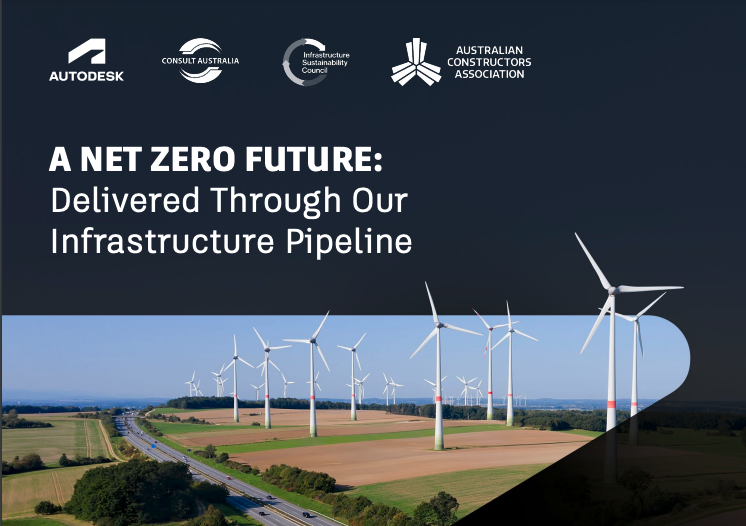
In Australia, collective action is needed to deliver low-carbon, climate-resilient infrastructure that meets community, Government, and investor requirements. Australian state and territory Governments have committed to net zero carbon by 2050 to address climate change risks identified by the Intergovernmental Panel on Climate Change (IPCC). All have set further intermediate 2030 benchmarks to drive action over the next decade. Additionally, almost every jurisdiction requires the infrastructure supply chains to deliver carbon reductions measured using the Infrastructure Sustainability Council Rating Scheme (IS Rating Scheme). The IS Rating Scheme is the Australian and New Zealand rating framework to assess the sustainability of the planning, design, construction and operation phases of infrastructure programs, projects, networks, and assets. The IS Rating Scheme evaluates governance, economic, environmental and social performance and has now become standard practice in most states and territories for any major transport project to plan and deliver carbon reductions, across a broad range of asset classes and sizes. Throughout Australia we have also started to see a range of targeted policy programs to incentivise innovation and uptake in low emissions building materials, renewable energy and the circular economy.
Our industry is strongly placed to help enable this transition over the next decade because of its role in shaping societies and economies and through its unique position to influence emissions reductions, leverage investment, and respond to policy incentives from government, proponents, and asset owners.
Return on Investment
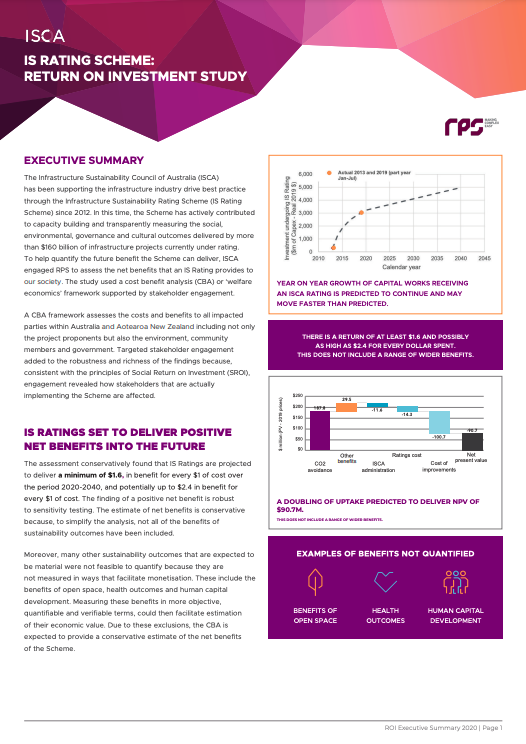
The Infrastructure Sustainability Council of Australia (ISCA) has been supporting the infrastructure industry drive best practice through the Infrastructure Sustainability Rating Scheme (IS Rating Scheme) since 2012. In this time, the Scheme has actively contributed to capacity building and transparently measuring the social, environmental, governance and cultural outcomes delivered by more than $160 billion of infrastructure projects currently under rating. To help quantify the future benefit the Scheme can deliver, ISCA engaged RPS to assess the net benefits that an IS Rating provides to our society. The study used a cost benefit analysis (CBA) or ‘welfare economics’ framework supported by stakeholder engagement. A CBA framework assesses the costs and benefits to all impacted parties within Australia and Aotearoa New Zealand including not only the project proponents but also the environment, community members and government. Targeted stakeholder engagement added to the robustness and richness of the findings because, consistent with the principles of Social Return on Investment (SROI), engagement revealed how stakeholders that are actually implementing the Scheme are affected.
Reshaping Infrastructure for a Net Zero Emissions Future
Infrastructure has a significant, lasting influence on Australia’s greenhouse gas emissions. Around 70% of Australia’s emissions are associated with infrastructure projects. Infrastructure assets built today will still be operating in 2050 when countries like Australia are expected to reach net zero emissions under the Paris Climate Agreement. Despite this, emissions reductions in line with a net zero emissions future are not effectively prioritised in infrastructure planning, design, procurement and operations across sectors. The Infrastructure Sustainability Council of Australia (ISCA) is partnering with ClimateWorks Australia and the Australian Sustainable Built Environment Council (ASBEC) to explore and define the role infrastructure can play in achieving a net zero emissions future. The purpose of this Issues Paper is to progress a new conversation to better understand the challenges and opportunities in reshaping transport, energy, water, communications and waste infrastructure for a net zero emissions world. Infrastructure bodies, governments, professional and industry associations, investors, designers, builders and operators have a shared responsibility to support the transition to net zero emissions within their own scope of influence, and collaborate with the broader sector to deliver solutions. These stakeholders are the audience for this report and the conversations it engenders. This conversation is timely. Governments and private investors are spending record amounts of money on new infrastructure. At the same time, infrastructure is facing pressure on two fronts to prepare for net zero emissions:
- All Australian states and territories have set commitments or aspirations to achieve net zero emissions by 2050, or earlier
- Private investors are increasingly aligning investment portfolios with net zero emissions in order to future-proof economic value and investment returns
Strategic infrastructure choices in both the public and private sector are made with key future trends in mind, such as population growth, urbanisation and new technologies. The global transition to net zero emissions is also a key trend relevant to today’s infrastructure choices. Emissions reduction strategies need to be coordinated with parallel efforts to build infrastructure that is resilient to the impacts of forecast climate change. A comprehensive analysis on the physical impacts of climate change for infrastructure is beyond the scope of this paper, but it is critical to acknowledge the importance of planning, designing and building resilience in infrastructure alongside our transition to a net zero emission future. Infrastructure unprepared for a net zero emissions future risks becoming ‘stranded’ due to significant and unanticipated losses of value and faces restricted pools of financing. On the other hand, there are growth opportunities available for infrastructure assets that are prepared for, and enable, the transition to a net zero emissions Australia.